


Last updated: August 30, 2026 · By: Tim Morris
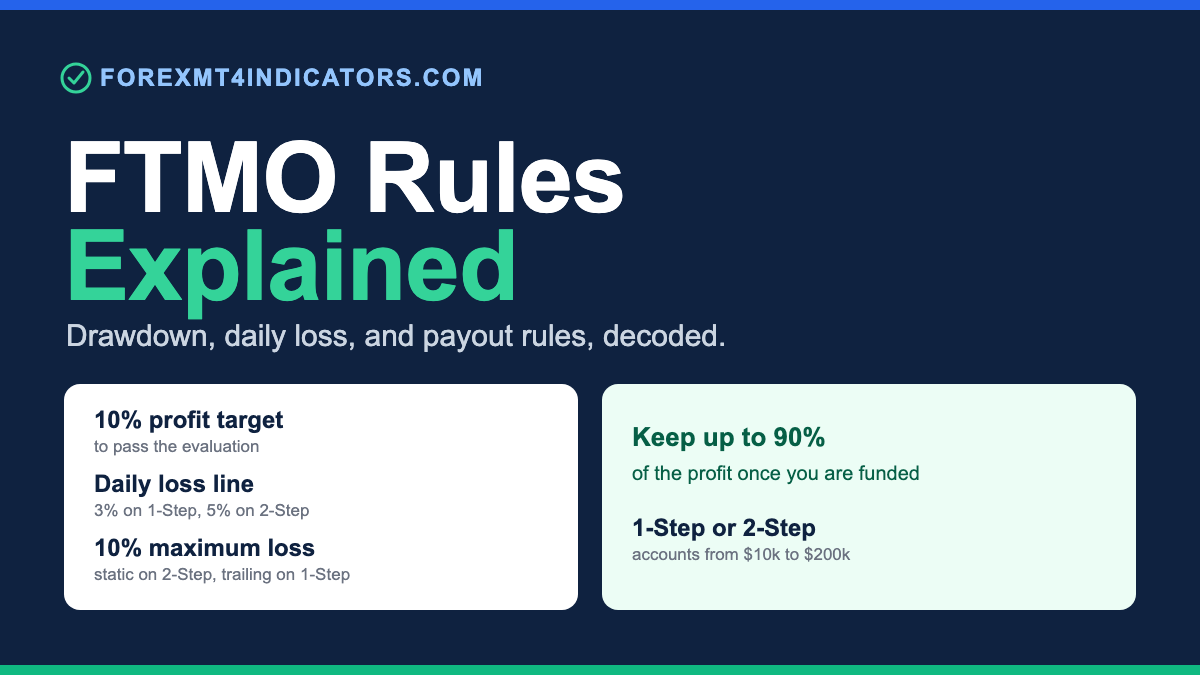
FTMO’s core rules are a 10% profit target, a daily loss limit (5% on the 2-step, 3% on the 1-step), a 10% maximum loss (static on the 2-step, trailing on the 1-step), a 4-day minimum on the 2-step, and a profit split that runs 90% from the first payout on the 1-step and 80% rising to 90% on the 2-step once you pass and trade a funded account.
FTMO runs a simulated evaluation: you prove you can trade inside fixed loss limits, then trade a funded account for a share of the results. The rules below are the exact numbers that decide whether you pass, get paid, or lose the account. Read them as mechanics, not marketing.
The chart above stacks FTMO’s three key levels in one view: the profit target you climb toward and the two loss lines you cannot touch. Every rule below hangs off those levels.
Rules and terms current as of August 2026; always verify on the firm’s official site before you buy.
The two FTMO models at a glance
The diagram above maps the two routes side by side: one phase on the 1-step, two phases on the 2-step, each path’s funded account keeping its own limits (3% daily plus a trailing max on the 1-step, 5% daily plus a static max on the 2-step).
FTMO sells two evaluation paths, and they carry different numbers, so the first thing to pin down is which one you bought. This guide stays on the rules themselves; for a verdict on who FTMO suits, see our separate FTMO review.
The 1-Step FTMO Challenge is a single phase. You hit a 10% profit target while respecting a 3% daily loss limit and a 10% trailing maximum loss, with a Best Day consistency rule layered on top. There is no second stage before funding.
The 2-Step FTMO Challenge splits the test across two phases. Step 1, the FTMO Challenge, asks for a 10% profit target; Step 2, the Verification, asks for 5%. Both steps run a 5% daily loss limit and a 10% static maximum loss, and both require a minimum of 4 trading days.
Clear either path and you move to a funded FTMO Account with no profit target, where the daily-loss and maximum-loss rules still apply. If this structure is new to you, our primer on what a prop firm is explains the evaluation-then-funded model before you commit money.
One naming note to avoid confusion: FTMO uses Challenge for the first phase of the 2-step and also as an umbrella label, while the 1-step is marketed as its own product. Match the rule numbers to the product you bought, since the daily-loss percentage and the drawdown type both change between them. The account currency, the platform, and the instruments stay the same across both.
The profit target
The profit target is the amount your account must grow before a phase counts as passed. On both FTMO models it is set as a percentage of your starting balance, not a dollar figure you negotiate.
On the 1-Step Challenge, the target is 10%. On the 2-Step, Step 1 asks for 10% and Step 2 (Verification) asks for 5%, which is lower because the firm has already seen you reach 10% once.
The funded account has no profit target at all. After you pass, the goal shifts from proving growth to protecting the account while you take payouts, so the daily-loss and maximum-loss rules become the only hard limits left.
One practical point: reach the target and settle above it rather than spiking through on a single floating trade, because an open position can give the number back before you close it. Plan the target as a level you close above, not a level you touch for a second. To turn the percentages into a trade-by-trade path against your risk per trade, our prop firm challenge planner does the layout for you.
The maximum daily loss (how it recalculates each day)
The maximum daily loss caps how much your account can fall inside a single trading day. Break it once and the attempt ends, even if the account is green for the week.
On the 1-Step Challenge the daily limit is 3%. On both steps of the 2-Step Challenge it is 5%, and each funded account keeps the daily limit of the path taken: a 2-step-funded account has a 5% daily limit, while a 1-step-funded account keeps the 3% daily limit and the 10% trailing maximum loss.
The number that matters is not fixed for the life of the account; it recalculates every day. FTMO measures the day’s loss against your balance or equity at the start of that trading day, so the dollar value of a 3% or 5% limit moves as the account grows or shrinks.
On a $100,000 account, a 5% daily limit is a $5,000 drop measured from the day’s starting figure; on the 1-Step, a 3% limit is $3,000. Because it resets each day, a rough morning does not follow you into the next session, though a fast early loss can leave almost no room for the rest of the day. Most failed attempts end on a daily-loss breach during revenge trading, which is why our guide to passing a prop firm challenge treats staying inside this line as the first job.
The maximum loss and drawdown: static versus trailing
The diagram above lines up the daily-loss reset against the overall maximum loss, showing the static floor holding flat while the trailing floor climbs behind a rising balance.
This is the rule most people get wrong, and the difference between the two models lives here. The maximum loss is the total your account can fall from its reference point before the attempt is over. On both models the figure is 10%, but the reference point behaves differently.
On the 2-Step Challenge the maximum loss is static. It is fixed at 10% of your initial balance and does not move, so on a $100,000 account the floor sits at $90,000 for the whole evaluation, no matter how high your balance climbs first.
On the 1-Step Challenge the maximum loss is trailing. It recalculates once per day from your highest end-of-day balance and only moves up, never down, so intraday equity highs do not lift the floor. On a $100,000 1-Step account the line starts at $90,000, and as your end-of-day balance sets new highs the floor rises behind it, locking in a slice of your gains.
The practical effect: on the trailing model, a large open profit you give back can breach the account even though you are still above your starting balance. The static model is more forgiving late in a run; the trailing model punishes round-tripping a winner. Our prop firm trailing drawdown calculator shows exactly where the moving floor sits after each new balance high.
One habit covers both models: bank partial profit and move on, rather than sitting on a large unrealised gain the trailing floor can claw back. On the static model the same habit keeps you clear of the fixed floor as the account nears the target.
Minimum trading days and time limit
FTMO sets a floor on how many days you must trade, not a ceiling on how long you can take. On the 2-Step Challenge, each step (the Challenge and the Verification) requires a minimum of 4 trading days. A trading day counts when you open or close at least one position.
For the 1-Step Challenge, FTMO does not specify a minimum number of trading days in the same way, so the pass hinges on the target and the loss limits rather than a day count. That does not make it a sprint, and rushing usually adds risk rather than removing it.
Neither model carries a time limit. The trading period is indefinite, so you are not racing a 30-day clock and can wait for setups you actually like. That removes one classic pressure, but it does not remove the loss limits, which apply every day you are active.
The Best Day (consistency) rule on the 1-Step
The 1-Step Challenge adds a consistency check that the 2-Step does not. A single best day cannot exceed 50% of your total profit across all your profitable days.
In plain terms, your gains have to come from more than one lucky session. If you make most of your target on one outsized day, that day is measured against the sum of your winning days, and the account will not pass on a lopsided profit distribution.
The fix is to spread your winners. Aim for several moderate green days rather than one heroic one, which also happens to be how sustainable trading tends to look. Our prop firm consistency calculator checks whether any single day breaks the 50% share before you submit.
Standard versus Swing account: holding and news rules
FTMO offers two account types, Standard and Swing, and they differ on what you are allowed to hold and trade. These restrictions apply on the funded account, not during the evaluation phases.
The Standard account requires you to close before the weekend and before any market break or rollover longer than 2 hours, plus a short window around selected news on targeted instruments. Ordinary weekday overnight forex holds are allowed on Standard, so an intraday or weekday-overnight strategy is fine, while a strategy that must sit through a weekend gap or trade the minutes around a news release is blocked.
The Swing account removes all of them and is offered within the 2-Step Challenge. You can hold over weekends, hold overnight, and trade news freely. The trade-off is leverage: the Swing account caps leverage at 1:30, versus 1:100 on the Standard account.
Pick the account type around your strategy, not the other way round. A news trader or a swing trader who needs weekend exposure takes the leverage cut on Swing; an intraday trader who flattens by the close keeps the higher 1:100 on Standard.
Account sizes, profit split, and the fee refund
FTMO offers evaluation accounts in five sizes: $10,000, $25,000, $50,000, $100,000, and $200,000, all in US dollars. The rules (percentages, day minimums, loss limits) are identical across sizes; only the dollar amounts scale.
Bigger accounts do not change the rules, only the stakes: a 5% daily loss is $2,500 on a $50,000 account and $10,000 on a $200,000 account. Choose the size you can trade calmly, because the same percentage risk feels different when the dollar swings are larger. Passing is about behaviour inside the limits, and the limits stay proportional whichever size you pick.
The profit split is where funded traders get paid. The share is model-specific: a 1-Step funded account starts at an immediate 90% split from the first payout, while a 2-Step funded account starts at 80% and scales to 90%, with the firm taking the remainder.
There is also a fee mechanic worth knowing. FTMO refunds 100% of your initial challenge fee on your first reward withdrawal, but this applies to the 2-Step Challenge only; the 1-Step fee is non-refundable. That refund is tied to reaching that first withdrawal, not to signing up.
To model what a given split and account size turn into at different profit levels, our prop firm payout calculator does the arithmetic. Keep in mind these are shares of simulated profit governed by the firm’s own payout schedule, and none of it is a promise of what you will earn.
What actually breaches an account (worked $100k example)
The diagram above walks a $100,000 account into each failure point: the fixed $90,000 floor on the static model, and the moving floor that follows equity up on the trailing model.
Rules are easier to feel with dollars attached, so here is a $100,000 account under each model. Treat these as illustrative round numbers, not the exact figures FTMO shows on your dashboard.
On a $100,000 2-Step Challenge, the 10% profit target is $10,000, so Step 1 passes when the balance reaches $110,000. The 5% daily loss is a $5,000 drop measured from the day’s starting figure. The 10% static maximum loss fixes the floor at $90,000: if equity ever touches $90,000, the account fails, regardless of how high it climbed earlier.
On a $100,000 1-Step Challenge, the 3% daily loss is a $3,000 drop in a day. The 10% trailing maximum loss starts at $90,000 and rises as your end-of-day balance sets new highs. Push the balance to $105,000 and the trailing floor lifts behind it, so a pullback that would be harmless on the static model can end the trailing one.
Two accounts, the same 10% headline, different failure points. On the static model you defend a fixed $90,000; on the trailing model you defend a line that follows your equity up. Knowing which line you are defending changes how much open profit you are willing to risk giving back.
Common mistakes when reading FTMO’s rules
- Assuming both models drawdown the same way. Traders copy a 2-step plan onto a 1-step account and get caught by the trailing floor. Fix: confirm whether your maximum loss is static or trailing before your first trade, because it changes how much open profit you can risk.
- Treating the daily loss as a fixed dollar figure. The limit recalculates from each day’s starting balance or equity, so yesterday’s dollar cushion is not today’s. Fix: recompute your daily dollar limit at the open of every trading day, not once at signup.
- Racing an imaginary clock. People force trades because they think a deadline is closing in. Fix: remember the evaluation has no time limit, so wait for setups instead of manufacturing them.
- Ignoring the Best Day rule on the 1-step. A single outsized day can clear the target on paper yet fail the consistency check. Fix: spread your profit across several days so no one day exceeds 50% of the total.
- Picking Standard when the strategy needs Swing. A weekend or news trader on a Standard funded account keeps hitting blocked-trade rules. Fix: choose Swing if you hold over weekends or trade news, and accept the 1:30 leverage cap.
- Reading the profit split as guaranteed income. The split (90% on the 1-step, 80% rising to 90% on the 2-step) is a share of simulated profit, not a paycheck. Fix: treat payouts as a percentage of whatever you actually make, which may be nothing, and size risk to survive first.
Frequently asked questions
What are FTMO’s rules?
FTMO’s rules set a profit target, a maximum daily loss, and a maximum overall loss for each evaluation, plus a minimum trading-day count on the 2-step. The 1-step uses a 10% target, a 3% daily loss, and a 10% trailing maximum loss with a Best Day consistency check. The 2-step uses a 10% then 5% target across two phases, a 5% daily loss, a 10% static maximum loss, and a 4-day minimum on each step.
What is FTMO’s maximum drawdown?
FTMO’s maximum loss is 10% on both models, but the reference behaves differently. On the 2-step it is static, fixed at 10% of your initial balance, so a $100,000 account fails if equity reaches $90,000. On the 1-step it is trailing, sitting 10% below your highest end-of-day balance and rising once per day as that balance sets new highs, never moving down.
What is FTMO’s daily loss limit?
The daily loss limit is 3% on the 1-step Challenge and 5% on both steps of the 2-step Challenge, and each funded account keeps its path’s limit: 5% daily on a 2-step-funded account, 3% daily plus the 10% trailing maximum loss on a 1-step-funded account. It recalculates each day from your balance or equity at the start of that trading day, so the dollar figure moves with the account. Break it once and the attempt ends, even if the account is in profit for the week.
How many trading days do you need on FTMO?
The 2-step Challenge requires a minimum of 4 trading days on each step, the Challenge and the Verification. A trading day counts whenever you open or close at least one position. FTMO does not specify a minimum number of trading days on the 1-step in the same way, and neither model carries a maximum time limit.
What is the difference between the 1-step and 2-step FTMO Challenge?
The 1-step is a single phase with a 10% target, a 3% daily loss, a 10% trailing maximum loss, and a Best Day consistency rule. The 2-step splits into a 10% target Challenge and a 5% target Verification, both with a 5% daily loss, a 10% static maximum loss, and a 4-day minimum. The headline drawdown is 10% either way, but static versus trailing is the practical difference.
What is FTMO’s Best Day (consistency) rule?
The Best Day rule applies to the 1-step Challenge and limits how concentrated your profit can be. A single best day cannot exceed 50% of your total profit across all profitable days. In practice that means your gains must come from more than one session, so a lopsided one-day spike will not pass.
What profit split does FTMO pay?
On a funded FTMO Account the split is model-specific: the 1-Step starts at an immediate 90% from the first payout, while the 2-Step starts at 80% and scales to 90%, with the firm taking the rest. FTMO also refunds 100% of your initial challenge fee on your first reward withdrawal, but only on the 2-Step Challenge; the 1-Step fee is non-refundable. The split is a share of whatever profit you actually generate, not a promise of any income.
Can you hold trades over the weekend on FTMO?
It depends on your funded account type. The Standard account requires closing before the weekend and before any market break or rollover longer than 2 hours, plus a short window around selected news on targeted instruments, though ordinary weekday overnight forex holds are allowed and none of this applies during the evaluation. The Swing account removes all of them and is offered within the 2-Step Challenge, so you can hold over weekends and overnight and trade news, in exchange for a lower 1:30 leverage cap.
Ready to put this into practice?
Open an account with a regulated broker and apply what you have learned. These are the three brokers we recommend:
Trading forex and CFDs carries a significant risk of loss and is not suitable for everyone. Broker links are affiliate links — we may earn a commission at no cost to you.