


Last updated: August 29, 2026 · By: Tim Morris
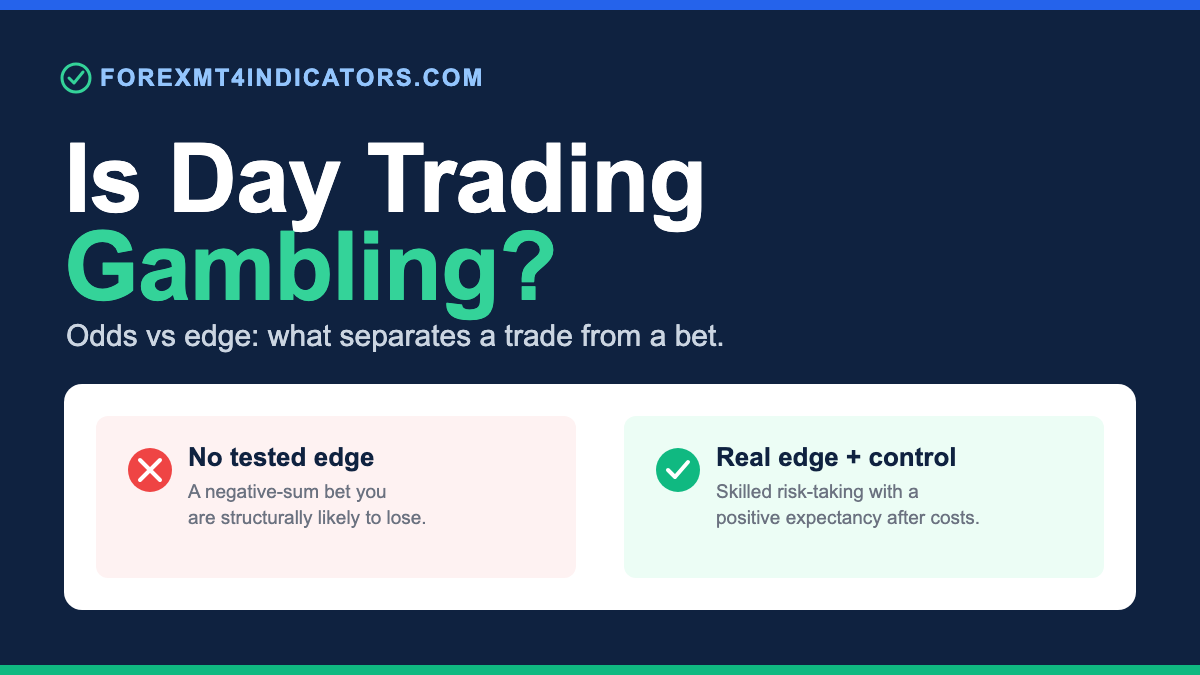
Day trading without a tested, positive-expectancy edge behaves like gambling: you are paying a real cost to bet on an outcome you cannot tilt in your favour. With a genuine edge and strict risk control it becomes speculation with managed variance: skill applied to an uncertain result, not a wager on luck.
The honest answer is that day trading sits on a spectrum, and where any single trader lands depends on their method, not on the market. This guide draws the line between odds and edge (the property that separates a bet from a business) and shows how to check which side of it your own trading is on. It stays on the legitimacy question and hands off the cost math, the how-to, and the reading list to their own guides.
What actually makes something gambling
Start with what gambling actually is, structurally, rather than how it feels. A casino game is negative-sum: the house builds a fixed edge into the rules, so the average player loses over time no matter how they play. Roulette pays 35 to 1 on a number that hits 1 in 37, and no betting pattern changes those odds. The player has no way to tilt the maths in their favour, and the more they play, the more certain the house edge grinds them down.
Three features define that kind of bet. The game is negative-sum after the house takes its cut, the odds are fixed and beyond your control, and skill cannot move them. When people say day trading is gambling, they are claiming trading shares all three: that the market has a built-in edge against you and that nothing you do changes your odds.
Part of that is fair. Trading is not free: spreads, commissions, swaps, and slippage act like a small house edge you pay on every position. If you trade with no method that overcomes those costs, you are in a negative-sum game with a house edge, which is gambling by the structural definition, whatever platform it runs on.
The difference is control. In roulette the odds are locked, while in markets price is set by other participants, so a trader who reads structure, manages risk, and takes only high-quality setups can shift the odds in their own favour. That possibility (earned, never automatic) is what separates a trade from a spin of the wheel.
This is why not every game in a casino is the same bet. Slots and roulette are pure chance with locked negative odds, but a skilled poker player or a disciplined blackjack card counter can hold a positive expectancy against the table. Trading belongs with that second group in principle (a contest where an edge is possible), which is exactly why the method, and not the label, decides what you are doing.
How trading can carry a positive expectancy
An edge is a repeatable reason your trades make more than they lose over a large sample, after costs. It is not a feeling or a hot streak; it is a measurable tilt in the odds that shows up across hundreds of trades. An edge can come from a structural pattern, a timing filter, a volatility condition, or the discipline to cut losers fast and let winners run: anything that makes your average outcome positive once every cost is subtracted.
Expectancy is the number that captures it. In words, expectancy equals your win rate times your average win, minus your loss rate times your average loss. It tells you what one trade is worth on average across many repetitions: positive means the method makes money over time, negative means it bleeds. You can run your own numbers through our expectancy calculator instead of estimating them in your head.
A high win rate is not the goal; positive expectancy is. A method that wins 40% of the time but makes three times its risk on winners can carry a strong positive expectancy, while one that wins 70% of the time with tiny winners and occasional large losers can be negative. The trade-off between how often you win and how much you win when you do is the heart of the maths, and our risk-reward and win-rate matrix shows which combinations break even and which clear it.
A worked example makes the trade-off concrete. Suppose you risk one unit per trade, win 40% of the time, and your winners average two units while your losers average one. Expectancy is 0.40 times 2, minus 0.60 times 1, which is 0.80 minus 0.60, a positive 0.20 units per trade on average. Flip the win rate to 60% but shrink winners to half a unit, and the same formula turns negative, which is how a trader who wins more often can still lose money over time.
Costs decide the honest version of the number. A method that looks positive on raw price can turn negative once spread, commission, and slippage are charged to every trade, which is why real expectancy is always measured after costs, not before. This is the single figure that answers whether your trading is speculation or a bet, and it is knowable, not a matter of opinion.
Why day trading feels like gambling even with an edge
A positive edge does not deliver a smooth, rising equity curve. It delivers a jagged one, because variance (the random scatter of wins and losses around your average) dominates any short run of trades. An intraday trader who takes five to ten positions a day can have a losing week with a method that is profitable over a year, and nothing has gone wrong. This gap between a real edge and a bumpy result is where the gambling feeling lives.
Losing streaks are a feature of the maths, not a sign the edge is broken. A method that wins 45% of the time will string together five, six, or more losers in a row with ordinary frequency over a few hundred trades. Seeing that run of red feels like the wheel is rigged, but it is the expected behaviour of a positive-expectancy system, and you can check how likely any streak is with our losing-streak probability calculator.
Small samples are the trap. Over ten trades, a skilled trader and a reckless one can post identical results, because ten trades tell you almost nothing about either edge. Only across a large sample does skill separate from luck, and the human brain (wired to find patterns in noise) reads meaning into stretches that are pure variance. A good week can feel like mastery and a bad week like proof you are gambling, when neither is true.
The practical cost of variance is emotional, and it is where discipline breaks. The drawdowns that a sound method produces are the exact moments traders abandon the plan, widen risk to win it back, or quit a method right before it recovers. Surviving variance is a skill in itself, and it is the reason two traders with the same strategy can end a year in different places.
The behaviours that turn trading into gambling
Whatever the market allows, a trader can choose to gamble. The behaviours below strip the edge out of trading and leave the coin-flip underneath, and they are what most people are picturing when they watch someone blow an account in a month.
Trading with no plan and no tested edge is the first. If you have never measured your expectancy and cannot say why your method should beat costs, you are betting on hope, and hope has no edge. Many of these habits are catalogued in our guide to common beginner forex mistakes, which reads like a list of ways to convert a market into a casino.
Revenge trading and chasing are next. After a loss, the urge to make it back immediately pushes traders into setups they would never take with a clear head, and chasing a move that already ran means entering at the worst price. Both are emotional reactions dressed as decisions, and both are covered in our notes on trading psychology, because the fix is mental before it is technical.
Over-leverage is the fastest of all. Sizing a position so a single normal losing streak can wipe your account turns even a positive edge into ruin, because you go broke before the maths can play out. Fixed, small risk per trade is what lets an edge survive variance, and our forex risk management guide for beginners lays out how to size positions so one bad run cannot end the game.
How to tell whether you actually have an edge
You find out the same way any claim is tested: with evidence, not conviction. Backtest the method over a meaningful stretch of history, then forward-test it on a demo or in small size, recording every trade with its entry, exit, and cost. If the rules are too vague to backtest, they are too vague to trade, and that vagueness is itself a warning.
Then judge it on sample size and expectancy. A handful of winning trades proves nothing; you want a large enough sample (often a few hundred trades) for variance to average out and the true expectancy to show. If that figure is positive after every cost is charged, you have evidence of an edge; if it is negative or you cannot produce the number, you are gambling until proven otherwise.
Two questions sit next to this one and deserve their own space. Whether the profit that survives those costs is worth the hours and stress is a separate calculation, worked with full cost and win-rate tables in our guide to whether day trading is worth it. And if you have decided to build a method, the entry rules, pairs, and timeframes belong in our day trading strategies for beginners, not here.
Common mistakes that turn a tested edge back into a bet
Judging your edge on a handful of trades. Ten or twenty results are noise, and reading them as proof leads you to drop good methods and trust bad ones. Fix: hold judgement until you have a few hundred recorded trades and a stable expectancy figure.
Confusing a win rate with an edge. A high hit rate can still lose money if the losers are large, and a low one can win if the winners are big. Fix: measure expectancy after costs, not the percentage of trades that close green.
Ignoring costs in the maths. Spread, commission, swap, and slippage quietly turn a positive method negative. Fix: charge every real cost to every trade before you call an edge positive.
Sizing to get rich instead of to survive. Large positions feel like conviction but hand variance the power to end your account. Fix: risk a small, fixed fraction per trade so no normal losing streak is fatal.
Abandoning a method inside a drawdown. Quitting during the losing streak a sound edge naturally produces locks in the loss right before the recovery. Fix: decide your maximum drawdown in advance and hold the plan until it is hit.
Trading without a written plan. An unwritten method changes shape every session, which makes its expectancy unmeasurable and its results random. Fix: write the entry, exit, risk, and review rules down, and trade only what is on the page.
The honest verdict
So, is day trading gambling? Without a tested, positive-expectancy edge and strict risk control, yes: it is a negative-sum bet you are structurally likely to lose. With a real edge, honest cost accounting, and position sizing that survives variance, it is speculation: skilled risk-taking on an uncertain outcome, closer to how a professional card counter works than to a slot machine.
The label is not fixed to the activity; it is fixed to how you do it. Two people can open the same platform and trade the same pair, and one is gambling while the other is running a small business with a measurable edge. The line between them is evidence: an expectancy number, earned over a real sample, that they can show you.
If you want to build that evidence properly, the discipline and maths are covered at book length by the field’s better authors, and we have gathered the ones worth your time in our roundup of the best day trading books. Read the method, test it yourself, and let your own expectancy (not a hunch) settle whether your trading is a bet or a business.
Frequently asked questions
Is day trading gambling?
It depends entirely on method. Without a tested, positive-expectancy edge and risk control, day trading is structurally a negative-sum bet: gambling in all but name. With a real edge measured over a large sample and disciplined position sizing, it is speculation: skilled risk-taking rather than a wager on luck.
Is intraday trading gambling?
Intraday trading (opening and closing positions within the same day) follows the same rule as any day trading. The short holding time means more trades and more exposure to costs and noise, which raises the bar for a genuine edge. It is gambling when there is no tested edge behind it and speculation when there is, exactly as with any timeframe.
What is the difference between trading and gambling?
Gambling is a negative-sum bet with fixed odds you cannot influence, so the average player loses over time by design. Trading carries real costs that act like a house edge, but a skilled participant can tilt the odds in their favour by managing risk and taking only quality setups. Control over the odds is the dividing line: you have some in trading and none in a casino game.
What is an edge in trading?
An edge is a repeatable reason your trades earn more than they lose across a large sample, after every cost. It shows up as a positive expectancy: your win rate times your average win, minus your loss rate times your average loss. An edge can come from structure, timing, volatility, or disciplined trade management, but it only counts once it survives real costs.
Why does day trading feel like gambling?
Because variance dominates any short run of trades, even a profitable method produces losing streaks and jagged results. Small samples of ten or twenty trades tell you almost nothing, so good and bad stretches both feel like luck. The human brain reads patterns into that noise, which makes a normal drawdown feel like a rigged wheel when it is ordinary maths.
Is forex day trading gambling?
Forex day trading faces the same test as any market: no tested edge means it behaves like gambling, and a real edge with risk control makes it speculation. Forex adds tight spreads, high leverage, and 24-hour access, which can make reckless trading easier and cheap over-leverage more tempting. The maths does not change: expectancy after costs still decides which side of the line you are on.
How do I know if I have a real trading edge?
Backtest your method over a meaningful history, then forward-test it in a demo or small size while recording every trade and its costs. Judge the result on a large sample (often a few hundred trades) and check whether the expectancy is positive after spread, commission, and slippage. If the figure is positive you have evidence of an edge; if it is negative or unmeasurable, treat your trading as a bet until proven otherwise.
Can day trading be done responsibly?
Yes, when it is treated as skilled risk-taking rather than a shortcut to money. That means a written plan, an edge you have tested, fixed small risk per trade, and the discipline to hold the method through the drawdowns variance produces. Done that way, day trading is a demanding profession with real risk, not a casino game, and it still suits only capital you can afford to lose.
Ready to put this into practice?
Open an account with a regulated broker and apply what you have learned. These are the three brokers we recommend:
Trading forex and CFDs carries a significant risk of loss and is not suitable for everyone. Broker links are affiliate links — we may earn a commission at no cost to you.