


Last updated: August 30, 2026 · By: Tim Morris
Swing traders need a prop firm that allows overnight and weekend holds without penalty. The safest choices offer this on both the evaluation and funded stages, use a static (not trailing) drawdown, and handle swap fairly. FTMO’s Swing account, and a few others, remove the usual holding restrictions that trip up multi-day trades.
This page compares prop firms by one filter that matters to swing traders: can you hold a position through the night, the weekend, and a news release without breaking a rule. You will get a plain checklist of what makes a firm swing-friendly, why the drawdown type decides more than any other setting, and a side-by-side you can run yourself. We hold no affiliate relationship with any firm, so treat every specific below as a starting point to verify, not a recommendation.
What “swing-friendly” actually means (the checklist)
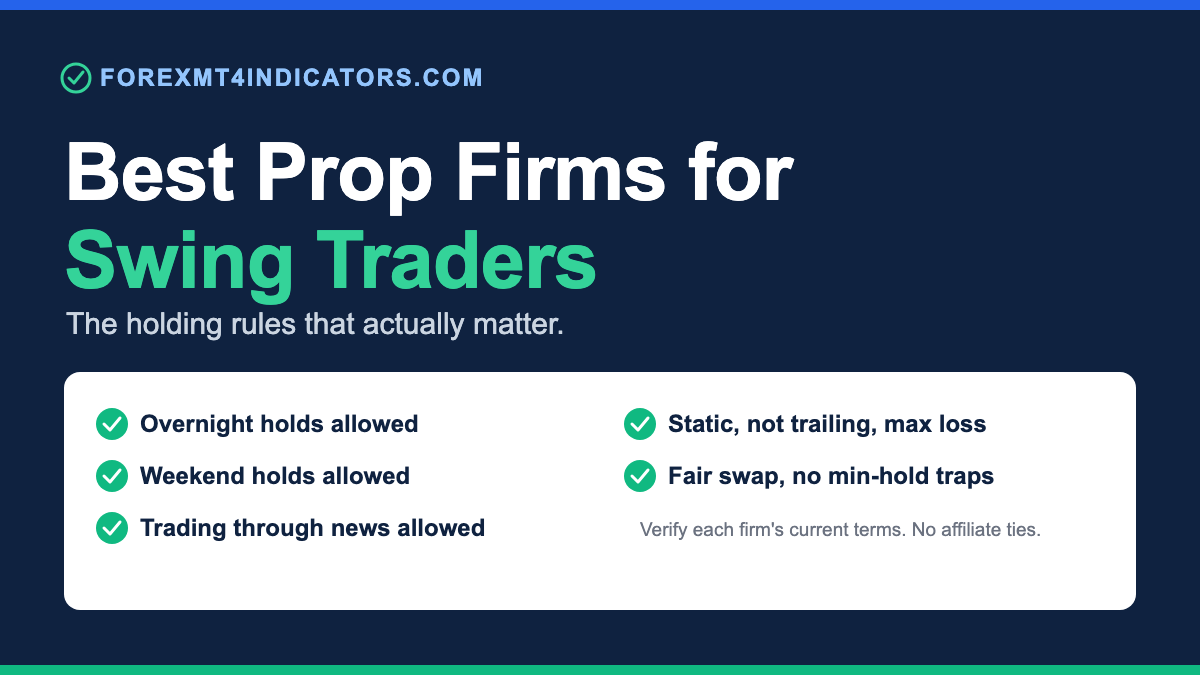
Swing trading holds a position for several days to a few weeks, so your account crosses at least one daily rollover and usually a weekend. A prop firm is swing-friendly when it lets you do that without tripping a rule or paying a hidden penalty. Six conditions decide it, and a firm has to clear all six, not most of them.
Read every one of these as a two-part question, once for the challenge and once for the funded account. A firm that advertises swing-friendly terms on its funded accounts can still run an intraday-only evaluation, and you have to clear that evaluation first. The rules that decide whether you keep the account are the ones you meet after you pass, so weight the funded terms most.
Before you shortlist any firm, get clear on how a funded account works and what the evaluation demands. Our primer on what a prop firm is covers the model end to end. The checklist below is the swing-specific layer that sits on top of it.
- Overnight holding allowed. The firm must permit positions to stay open past the daily rollover, on both the evaluation and the funded account. Some firms allow it once you are funded but restrict it during the challenge, which quietly blocks swing entries in the stage that matters.
- Weekend holding allowed. You can carry a position from Friday close, through the weekend gap, into Monday. Firms that force a Friday flat-close turn every swing trade into a countdown instead of a plan.
- News holding allowed. You are permitted to hold through scheduled high-impact releases rather than being required to be flat around them. A firm that voids trades placed or held near news makes multi-day positions fragile.
- Static (not trailing) max-loss. Your maximum loss is measured from a fixed starting balance, not from a high-water mark that ratchets up with unrealized profit. This single setting matters more than any other on the list, for reasons the next section makes concrete.
- Transparent swap and carry handling. The firm publishes how overnight swap is credited or debited and applies it the way a normal broker would. Hidden or punitive carry costs erode a position you hold for a week.
- No minimum-hold or forced-close gimmicks. No rule forces you to hold for a set time, and none auto-closes winners early or caps how long a trade may stay open. Gimmicks like these are built around scalping metrics, not multi-day trading.
A setup like the inside bar swing trade only works when the firm lets the trade breathe for days. If any one of these six fails, your strategy and the rulebook are fighting each other, and the rulebook wins.
Why the drawdown type matters most for swing traders
Of the six conditions, drawdown type is the one that quietly ends the most funded swing accounts. A max-loss rule sets the floor your equity is not allowed to touch, and firms calculate that floor in one of two ways. Static (or absolute) drawdown fixes it against your starting balance. Trailing drawdown moves the floor upward as your account prints new highs.
A trailing floor sounds generous because it rises with your gains, yet it turns your best unrealized profit into a liability. Say a $100,000 account trails by $5,000 on live equity. Open a swing position, ride it to $103,000 in unrealized profit, and the floor ratchets up to $98,000. Give that open profit back on a routine pullback, which multi-day trades do all the time, and you breach at $98,000 even though a static $95,000 floor would still be intact, stopped out while your equity sits well above your original hard floor rather than while green.
Static drawdown avoids that whipsaw. The floor stays at $95,000 no matter how high your open profit climbs, so a pullback inside a winning trade never moves you closer to a breach than where you began. That is why swing traders favor a static or end-of-day-balance max-loss and treat a live-equity trailing rule as a warning sign.
A separate daily loss limit usually sits alongside the overall max-loss, and it matters for holds too. Most firms reset that daily figure at a fixed hour, often the platform’s midnight, so an open swing position carries its floating loss across the reset. Know when your firm’s trading day rolls over, because a position that looks safe at one clock can sit near the daily limit at another. The daily limit is measured on the same equity your open trades move, so it tightens exactly when a hold goes against you.
Before you commit, model the exact rule rather than guessing at it. Our prop firm trailing drawdown calculator shows how a trailing floor tracks a position as your equity swings, so you can see whether a firm’s math survives the way you actually hold trades. Read the firm’s own definition too, because “trailing” trails on equity at some firms and only on closed balance at others.
FTMO’s Swing account and its holding rules
FTMO is the most-cited name in this category because it splits the decision into two clearly labeled account types. Its Standard account allows ordinary weekday overnight forex holds; on a funded Standard account you must close before the weekend and before any market break (rollover) longer than 2 hours, plus avoid a short window around selected news. Those weekend, long-break, and news restrictions apply only on the funded account, not during the evaluation. Its dedicated Swing account removes the weekend, long-break, and news restrictions, and it is available only within the 2-Step Challenge.
The trade-off is leverage. FTMO caps the Swing account at 1:30, versus 1:100 on the Standard account. Lower leverage means a given position ties up more margin, so you size trades against that ceiling rather than assuming the Standard account’s room.
For most swing traders that trade is worth taking: you would rather hold freely at 1:30 than be forced flat at 1:100. Read the full ruleset before you buy, because holding permissions are one section of a larger rulebook. Our breakdown of the FTMO rules walks the profit targets, loss limits, and holding terms, and our FTMO review covers the wider funded-account experience.
Other firms commonly allowing weekend holds
FTMO is not the only route. The5ers is commonly cited as allowing weekend holding across its account types, without requiring you to buy a separate swing product. If that still holds when you check, it removes the account-type decision entirely, because holding becomes the default rather than an upgrade.
Beyond those two, several firms advertise overnight and weekend holding as standard, and a handful market themselves specifically to swing and position traders. The specifics move often: an overnight allowance, a news policy, or a drawdown type can change between funding rounds. Treat any number you read on a forum or a third-party table as commonly reported, and confirm it on the firm’s own current terms.
Two more clauses deserve a look on any swing shortlist. Some firms attach a consistency rule that caps how much of your total profit can come from a single day or trade, which can clash with one swing winner that runs for a week. Others scale your account only after you meet holding-period or trade-count minimums. Read both against how you actually trade, since a clause written for day traders can penalize a patient position.
The pattern to look for is a firm that treats holding as normal and prices it into its model, not one that tolerates holding but hedges it with fine print. Run each candidate through the six-point checklist above. A firm can pass overnight, weekend, and news holding and still be a poor fit if it uses a live-equity trailing drawdown.
Swing-friendly prop firms compared, side by side
The table below is our own snapshot, read from each firm’s official rules pages and dated the month we checked. Because any such table goes stale the moment a firm updates its terms, treat it as a starting point and confirm each cell on the firm’s own page before you fund. We hold no affiliate relationship with any firm listed, and where a rule could not be confirmed on a live page the cell says so.
| Firm / account | Overnight hold | Weekend hold | Hold through news | Drawdown type | Swap handling |
|---|---|---|---|---|---|
| FTMO Swing account (2-Step only) | Allowed | Allowed | Allowed | Static, from initial balance | Standard swap; leverage 1:30 |
| FTMO Standard account | Weekday allowed | Restricted (funded only) | Restricted (funded only) | Static, from initial balance | Standard swap; leverage 1:100 |
| FTUK (Two-Step, static) | Allowed (eval and funded) | Allowed (eval and funded) | Holding allowed; full news-trading is a paid add-on on evals | Static on Two-Step (8% max, 5% daily); One-Step and Instant trail | Swap-free on all instruments |
| City Traders Imperium (2-Step) | Allowed (all programs) | Allowed (all programs) | Allowed, no time window | 2-Step static 10%, floating loss never counts; 1-Step trails closed profit | Verify current terms |
| The5ers (all programs) | Allowed (eval and funded) | Allowed; high index swap over weekend | Holding allowed; High Stakes bars a new order within 2 min of high-impact news | Static from initial balance, plus end-of-day daily loss | Standard swap; swap-free on funded via support |
| FundedNext (Stellar CFD) | Allowed (eval and funded) | Allowed; triple swap Wed and Fri | Holding allowed; funded counts only 40% of profit in the news window | Static on 2-Step, 1-Step, Lite (10%, 6%, 8% max); Instant trails | Standard swap; optional swap-free add-on |
| E8 Markets (E8 Pro) | Allowed on all stages | Allowed on all stages | Unrestricted on E8 Pro | Static 8% on E8 Pro; E8 One and Signature trail | Standard swap; swap-free add-on (+10% fee) |
| Blueberry Funded (1-Step / 2-Step) | Allowed (eval and funded), not stock accounts | Allowed on standard plans, not Flex 1-Step | Holding allowed; no open or close within 2 min of red-folder news | Static on 1-Step (6% max, 4% daily) and 2-Step (10% max, 5% daily); 3-Step and Instant trail | Standard swap; triple over weekend; no swap-free confirmed |
| FundingPips (standard models) | Allowed | Eval allowed; funded suspended since Jan 2026 (Friday auto-close) | Holding allowed; funded deducts news-window profit (5-hour swing exception) | Static on standard models; Zero trails | Standard swap; optional paid swap-free add-on |
| Audacity Capital (all programs) | Allowed (eval and funded) | Allowed (eval and funded) | Holding allowed; no open or close within 3 min of high-impact news | Static on Ability Challenge and Ability One; FTP trails equity | Standard swap; triple Wed and weekend; no swap-free stated |
Verified against each firm’s published terms as of August 2026. Rules change often, especially holding and drawdown terms, so confirm on the firm’s own current terms before funding.
Leverage matters for sizing too, since FTMO’s Swing cap of 1:30 versus 1:100 on Standard is the kind of detail a generic table hides, and it sits in the swap column above. When you price the funded stage, model the withdrawal side as well. Our prop firm payout calculator turns a profit split and target into what actually reaches your account, so a week’s swap cost is set against real payout math rather than a guess.
Score the table in order of severity, not left to right. Holding permissions and drawdown type are hard filters that disqualify a firm outright, so settle those first. Swap handling, leverage, and payout terms are trade-offs you weigh among the firms that survive. A candidate that fails a hard filter is off the list no matter how attractive its fees look.
How to verify a firm’s holding rules before you buy
Marketing pages simplify, and the rulebook governs. Before you pay for any evaluation, read the firm’s own terms document instead of the sales page, and confirm the holding rules apply to both the evaluation and the funded account. The two stages often differ, and the funded stage is the one you will live in.
Check the wording on each of the six conditions, and watch for conditional language. “Overnight holding allowed” can carry an exception around specific instruments or news windows, and “weekend holding allowed” sometimes excludes certain products. Screenshot the terms with the date visible so you can hold the firm to what you actually agreed to.
When the terms are ambiguous, ask the firm’s support in writing and keep the reply. A dated answer from the firm is worth more than a forum consensus, and it gives you something concrete if a rule is enforced differently later. Vague or slow answers on a simple holding question are themselves a signal about how the firm operates.
Re-check the terms each time you buy a new evaluation or reset, not once. Firms revise holding and drawdown rules between funding rounds, and the version you agreed to a year ago may not be the one that governs your next account. A two-minute re-read on purchase day is cheaper than a breached account on a rule you did not know had changed.
Then plan the challenge around those rules rather than against them. Our prop firm challenge planner helps you set daily risk against the loss limits, and our guide to passing the prop firm challenge covers pacing an evaluation you intend to hold trades in. If you trade longer horizons, the principles in risk management for long-term traders apply directly to sizing a multi-day position under a fixed max-loss.
We hold no affiliate relationship with FTMO, The5ers, or any prop firm, so nothing here is a referral, and the specifics can change without notice. Rules and terms current as of August 2026; always verify on the firm’s official site before you buy. When a forum figure and the official terms disagree, the official terms win.
Common mistakes swing traders make choosing a prop firm
- Assuming the evaluation and the funded account share the same holding rules. Many firms allow weekend holds once funded but restrict them during the challenge, or the reverse. Fix: confirm every rule for both stages before you buy, and plan the evaluation around the stricter of the two.
- Ignoring the drawdown type. A firm can allow overnight, weekend, and news holds and still be hostile to swing trading through a live-equity trailing floor. Fix: prefer a static or end-of-day max-loss, and model any trailing rule before you commit a cent.
- Forgetting swap on multi-day holds. A position held for a week pays or earns swap every night, and negative carry on a large position adds up fast. Fix: read the swap policy and factor nightly carry into your target, not the entry alone.
- Trusting a third-party comparison table as current. Firms change overnight, news, and drawdown rules between funding rounds, and old tables linger in search results. Fix: verify every cell against the firm’s official terms on the day you buy.
- Overlooking the leverage trade-off on swing accounts. A dedicated swing account can carry lower leverage, such as FTMO’s 1:30 cap versus 1:100 on Standard, which changes your position sizing. Fix: size your intended trades at the swing account’s leverage before deciding it fits.
- Buying on holding rules alone. A firm can be swing-friendly and still fail you on profit split, payout schedule, or platform quality. Fix: score holding rules first because they are a hard filter, then compare the survivors on cost and payout.
Frequently asked questions
Which prop firms allow swing trading?
FTMO’s dedicated Swing account is the most-cited option, and The5ers is commonly reported to allow weekend holding across its account types. Several other firms advertise overnight and weekend holding as standard, but the specifics change often. Verify each firm’s current official terms before you rely on any of them.
Can you hold trades over the weekend with a prop firm?
With some firms yes, with others no, and it often depends on the account type you pick. FTMO’s Swing account removes the weekend-holding restriction that applies to its Standard account, and The5ers is commonly reported to allow weekend holds without a separate product. Always confirm on the firm’s official terms, because weekend policies sometimes exclude specific instruments.
Does FTMO allow swing trading?
Yes. Its Standard account already allows weekday overnight forex holds, and a funded Standard account only asks you to close before the weekend, before any market break longer than 2 hours, and around selected news, with those restrictions applying on the funded account rather than the evaluation. Its dedicated Swing account removes the weekend, long-break, and news restrictions and is available only within the 2-Step Challenge. The trade-off is leverage: the Swing account is capped at 1:30 versus 1:100 on Standard, so read the firm’s full ruleset before you buy.
What is a swing account?
A swing account is a prop-firm account type that removes the holding restrictions on a firm’s standard product, so you can carry positions overnight, over the weekend, and through news. It exists because standard evaluation accounts are often built around intraday metrics that penalize multi-day holds. The common trade-off is lower leverage in exchange for the added freedom.
Why do some prop firms ban overnight holding?
Overnight and weekend gaps introduce risk the firm cannot manage while the market is closed, since a position can jump past a stop when trading reopens. Some firms also build their risk model around intraday-only trading to keep drawdown predictable. Banning the hold is a risk-control choice, not a judgment on your strategy.
What drawdown type is best for swing traders?
A static (absolute) max-loss measured from your starting balance is generally the friendliest for swing trading, because it does not ratchet up with your open profit. A live-equity trailing drawdown is the hardest to hold trades under, since a normal pullback in a winning position can move you toward a breach. If a firm uses a trailing rule, read exactly how and when it measures the floor.
Do prop firms charge swap on swing positions?
Most pass through overnight swap the way a normal broker does, crediting or debiting carry each night you hold. A few advertise swap-free or adjusted conditions, but the details vary and can change. Read the firm’s swap policy and factor nightly carry into any position you plan to hold for days.
Can you hold through news with a prop firm?
On some accounts yes and on others no, and the two are often different products at the same firm. FTMO’s Swing account removes the news-trading restriction that applies to its Standard account, while many standard evaluation accounts require you to be flat around high-impact releases. Confirm the news rule in the firm’s current terms, because it is one of the most frequently updated sections.
Ready to put this into practice?
Open an account with a regulated broker and apply what you have learned. These are the three brokers we recommend:
Trading forex and CFDs carries a significant risk of loss and is not suitable for everyone. Broker links are affiliate links — we may earn a commission at no cost to you.