


Last updated: August 30, 2026 · By: Tim Morris
FTMO is one of the oldest and most established forex prop firms, and its evaluation is strict but fair. Payouts and the up-to-90% profit split are well documented, and on the 2-Step Challenge the challenge fee is refunded on your first withdrawal (the 1-Step fee is not). It suits disciplined, risk-controlled traders, not gamblers chasing a fast payout.
This review covers what FTMO offers in 2026, how its two evaluation models work, and the payout terms that matter before you pay. We hold no affiliate relationship with FTMO, so the aim is an honest read that weighs real pros against real cons.
What FTMO is, in brief
FTMO is a proprietary trading firm that funds traders who pass a rules-based evaluation, then pays them a share of the profits they produce. It launched in 2015 and became one of the most recognised names in the retail prop space. If the model itself is new to you, start with our primer on what a prop firm is, then come back here for the FTMO specifics.
The pitch is easy to state. You pay a one-time evaluation fee, prove you can hit a profit target without breaking the risk rules, and FTMO gives you a funded account to trade. You keep the larger share of what you make.
One detail matters before anything else. FTMO accounts are simulated, evaluation-style accounts, not your own live brokerage capital. The firm pays your share from its own funds, so you are earning a payout for hitting targets under its rules, not compounding a live balance of your own.
That is standard for the online prop sector and is not a mark against FTMO specifically. It does change how you should think about the money, though. You are buying a funded-trader arrangement, not opening a personal trading account.
Two facts anchor the whole review. FTMO is not a broker holding your deposit; it is a firm that pays you for performance on its accounts. Passing is a skill test rather than a purchase, so the fee buys an attempt, not a funded seat.
How the model works at a glance
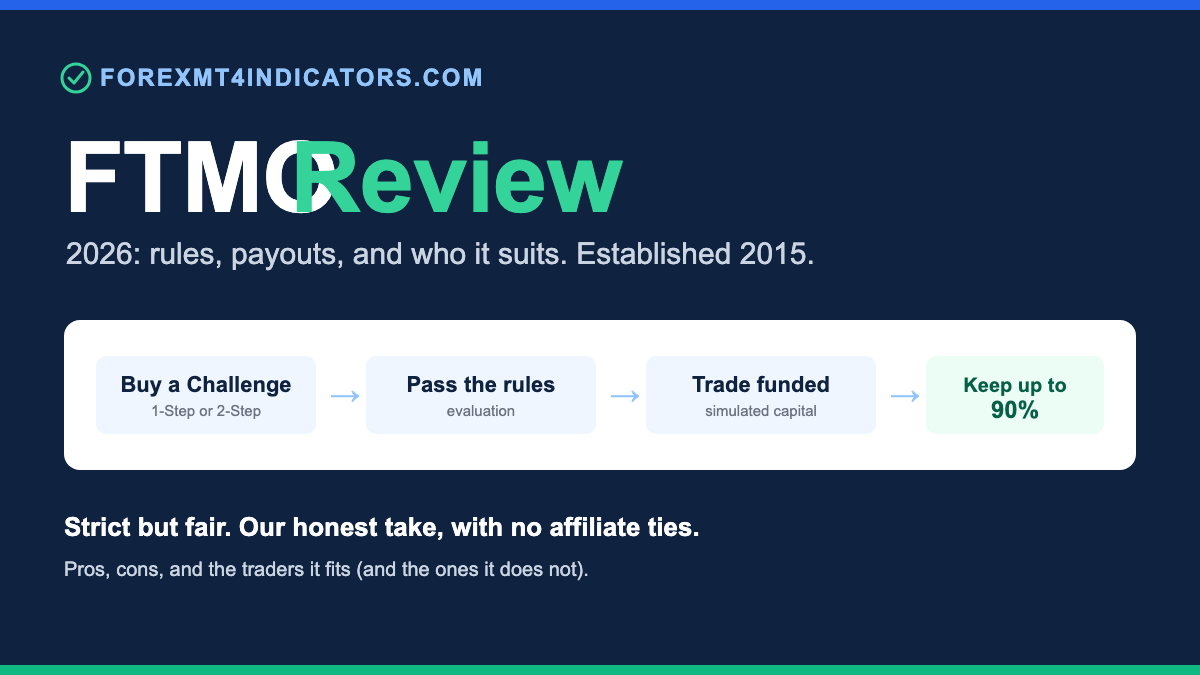
The path is the same three steps for every trader: pass an evaluation, receive a funded account, then withdraw a share of your profits. Where FTMO differs from many rivals is that it offers two evaluation models, and you choose which to buy.
The 2-Step FTMO Challenge is the classic route. Step 1 (the FTMO Challenge) asks for a 10% profit target; Step 2 (Verification) asks for 5%, mostly to prove the first pass was repeatable. Both steps require a minimum of 4 trading days and run under a 5% maximum daily loss and a 10% maximum loss. It starts you on an 80% profit split that scales to 90%, and it is the only model whose fee is refunded on your first payout.
The 1-Step FTMO Challenge compresses that into a single phase with a 10% profit target. It runs under a tighter 3% maximum daily loss, a 10% trailing maximum loss, and a “best day” consistency rule that stops one outsized day from carrying your whole pass. It starts at an immediate 90% split, but its fee is non-refundable.
FTMO offers account sizes of $10,000, $25,000, $50,000, $100,000, and $200,000. On a $100,000 2-Step Challenge, the 10% target means growing the account to $110,000, the 5% daily loss caps a single day’s drawdown at $5,000, and the 10% static max loss fails the account if equity ever touches $90,000. There is no time limit on the evaluation, so the trading period is indefinite.
The 1-Step model changes that math in two ways. On a $100,000 1-Step account, the 3% daily loss caps a single day at a $3,000 drop, tighter than the 2-Step’s $5,000. The 10% trailing max loss starts at $90,000 and rises as your balance sets new highs, so a profit run permanently lifts the floor beneath you.
The rules in brief
The fair summary of FTMO’s rules is strict but fair. The daily-loss limit and the maximum-loss limit are the two lines that fail most people, and FTMO enforces them without exception, which is why a disciplined trader can trust the outcome. Nothing here is designed to trap you; the rules are published, consistent, and the same for everyone.
The one nuance worth flagging is drawdown type. The 2-Step model uses a static 10% max loss fixed to your starting balance, while the 1-Step model uses a trailing 10% max loss that recalculates from your highest balance and only moves up. A trailing limit tightens as you profit, which catches traders who model it as static; our trailing drawdown calculator shows how the floor moves. For the exact mechanics of every limit, the consistency rule, and the account settings, read the full FTMO rules breakdown.
Payouts, profit split, and the fee refund
This is where FTMO’s reputation is strongest. A funded FTMO trader keeps up to 90% of the simulated profits, one of the higher splits in the sector, and the funded account carries no profit target: you keep respecting the daily-loss and max-loss rules and withdraw what you make.
FTMO refunds 100% of your initial challenge fee on your first reward withdrawal, but only on the 2-Step Challenge. The 1-Step Challenge fee is non-refundable; in exchange it starts you at an immediate 90% split, while the 2-Step opens at 80% and scales to 90%. In practice, a 2-Step trader who passes and reaches a first payout recovers the entry cost, so the net cost of that evaluation for a successful trader is effectively returned. Model different account sizes and split scenarios with our prop firm payout calculator.
The fee itself scales with account size, from the $10,000 tier up to $200,000, and is paid once per challenge attempt. That fee is the real cost you carry if you fail, so size the account to what you can afford to lose, not to the payout you are dreaming about. Our challenge cost calculator helps you compare tiers before you commit.
Set your expectations on timing, too. You do not withdraw on day one; you build a track record on the funded account first, then request a payout under FTMO’s schedule. Treat the split and refund as the reward for weeks of disciplined trading, not a same-week cash-out.
Payout reliability is the question every trader asks, and FTMO’s long public track record of processing withdrawals is one reason it sits among the trusted names. No firm can promise your results, but the mechanism, split, and refund are documented and consistent.
The pros
FTMO’s strengths are concrete rather than marketing gloss. These are the reasons it keeps its reputation.
- Track record and longevity. FTMO has operated since 2015 and is one of the most established firms in the space, which lowers the counterparty risk on your fee and future payouts.
- High profit split. Keeping up to 90% of profits sits at the generous end of the sector.
- Fee refund on first payout (2-Step only). Recovering 100% of your challenge fee on the first withdrawal lowers the real cost for traders who pass, though this applies to the 2-Step Challenge; the 1-Step fee is non-refundable.
- No time limit. With an indefinite trading period, you are not forced into rushed, oversized trades to beat a countdown.
- Two evaluation models. The 1-Step and 2-Step options let you match the rule set to your style and risk tolerance.
- Published, consistent rules. Nothing is hidden; the limits are the same for everyone and enforced predictably.
The cons
Honesty cuts both ways, and FTMO carries real drawbacks you should weigh before paying.
- Your fee is at risk. If you fail the evaluation, the fee is gone. Most applicants do not pass, and that is the firm’s economic reality.
- The rules are strict. The daily-loss rule ends far more challenges than the profit target does; one bad day can close an account you were winning on.
- It is a simulated model. You are trading an evaluation account and earning a payout, not building your own live capital.
- Results depend on you. Funding does not add edge. If your strategy is not already profitable on your own account, size alone will not fix it.
- Standard-account restrictions. The Standard account restricts holding over weekends, holding overnight, and trading during selected news on the funded account, which can clash with swing styles unless you pick the Swing account (which caps leverage at 1:30 versus 1:100).
- The learning curve costs money. Traders often fail more than one attempt before passing, and each attempt is a fresh fee.
Who FTMO suits (and who should skip it)
FTMO fits a specific kind of trader. If you already trade a small account with consistent risk control and a tested edge, the evaluation is a fair test of what you can do, and the split and refund reward you well for passing.
It also suits traders who cannot fund a large account themselves. Paying an evaluation fee to control $100,000 of buying power, and keeping most of the profit, is a rational trade for a disciplined operator who lacks the capital, not the skill.
You should skip FTMO if you are still learning the basics or hunting for a fast payout. The daily-loss rule is unforgiving to over-leveraged, emotional trading, and paying fee after fee on failed attempts is an expensive way to discover you are not ready. Study how to pass a prop firm challenge on a demo first, and buy the evaluation only when your results are already consistent.
One more group fits well: traders returning to size after a drawdown wiped their own account. If your process is sound but your capital took a hit, an evaluation lets you trade meaningful size again for a known, capped cost. The rules then force the discipline that protects you from repeating the mistake.
Swing and news traders should also read the account terms carefully. If holding through weekends or trading the news is central to your edge, the Swing account removes those restrictions, but its lower leverage cap changes your position sizing, so plan for that.
Common mistakes traders make on the FTMO challenge
- Treating the daily-loss limit as a soft guideline. A single reckless day ends more FTMO accounts than any other rule. Fix: set a hard personal stop at roughly half the daily-loss limit and walk away when you hit it.
- Front-loading one huge day. The 1-Step “best day” rule caps any single day at 50% of your total profit across profitable days, so one lucky spike will not pass you on its own. Fix: aim for several steady days and pressure-test the split with our consistency calculator.
- Buying too large an account. Chasing a bigger payout with a fee you cannot comfortably lose adds pressure that breaks discipline. Fix: start at a tier whose fee you can afford to write off entirely.
- Rushing because you expect a deadline. FTMO has no time limit, yet many traders trade as if a clock is running. Fix: trade your normal frequency and let the pass come at its own pace.
- Ignoring the Standard-account restrictions. Weekend holds, overnight holds, and selected-news trading are limited on the Standard funded account. Fix: match your account choice (Standard or Swing) to how you actually trade.
- Skipping demo preparation. Paying for a live evaluation before your edge is proven turns tuition into lost fees. Fix: rehearse the exact FTMO rules on a demo until passing feels routine.
The honest verdict
FTMO earns its reputation. Among online prop firms it is one of the most established, its rules are strict but fair, and its payout terms, the up-to-90% split and the 2-Step fee refund (the 1-Step fee is non-refundable), are documented and consistent rather than teaser marketing.
It is not a shortcut to income, and it should not be sold as one. The evaluation is a filter, most applicants fail it, and your fee is at genuine risk. If you already trade with discipline and a tested edge, FTMO is a fair and reputable way to trade larger size and keep most of the profit. If you are chasing a fast payout, it will likely cost you fees and teach a hard lesson.
Rules and terms current as of August 2026; always verify on the firm’s official site before you buy.
Frequently asked questions
Is FTMO legit?
Yes, FTMO is a legitimate, well-known proprietary trading firm that has operated since 2015 and has a long public record of paying withdrawals. It is open about its rules, fees, and simulated-account model. The main caveat is the one every prop firm shares: your evaluation fee is at risk if you fail.
Is FTMO worth it?
It is worth it for a disciplined trader who already has a tested, risk-controlled edge and wants to trade larger size than they can self-fund. For that trader, the up-to-90% split and the 2-Step Challenge’s first-payout fee refund make the economics attractive (the 1-Step fee is non-refundable). It is not worth it if your strategy is not yet consistently profitable, because funding does not add edge.
How much does FTMO cost?
FTMO charges a one-time evaluation fee that scales with the account size you choose, from the $10,000 tier up to $200,000. You pay the fee per challenge attempt, and on the 2-Step Challenge it is refunded in full on your first reward withdrawal after you pass; the 1-Step Challenge fee is non-refundable. Because pricing changes, confirm the current fee for your tier on FTMO’s official site before buying.
Does FTMO actually pay out?
FTMO has a long, public track record of processing trader withdrawals, which is a large part of why it sits among the trusted names in the sector. Funded traders keep up to 90% of simulated profits, and the funded account has no profit target. You still have to respect the daily-loss and max-loss rules to keep the account.
How much can you realistically make with FTMO?
There is no honest fixed answer, and anyone quoting a guaranteed figure is selling you something. Your return depends entirely on your own skill, consistency, the account size you trade, and how well you respect the risk rules over time. Many traders make nothing because they fail the evaluation or breach a rule, so treat any income as uncertain and earned, never promised.
Who is FTMO best for?
FTMO is best for disciplined, risk-controlled traders who already trade a small account profitably and want larger buying power without funding it themselves. It rewards patience, steady daily risk, and rule-following. It is a poor fit for beginners, gamblers, and anyone who needs money quickly.
What are FTMO’s biggest downsides?
The biggest downsides are that your fee is lost if you fail, the daily-loss rule is unforgiving, and the account is a simulated evaluation rather than your own live capital. The Standard account also restricts weekend holds, overnight holds, and trading selected news on the funded account. None of these are hidden, but they catch traders who do not read the terms.
Is FTMO a good first prop firm?
It can be, because its rules are clear and its reputation is strong, which lowers the risk of losing your fee to an unreliable firm. That said, “first prop firm” should never mean “first trading account.” Learn to trade profitably on a demo or a small live account first, then treat FTMO as the step that scales a skill you already have.
Ready to put this into practice?
Open an account with a regulated broker and apply what you have learned. These are the three brokers we recommend:
Trading forex and CFDs carries a significant risk of loss and is not suitable for everyone. Broker links are affiliate links — we may earn a commission at no cost to you.