


Last updated: June 30, 2026 · By: Tim Morris, founder of ForexMT4Indicators.com
Support and resistance are price levels where a market has repeatedly stopped and reversed. Support is a floor where buyers step in and halt a fall; resistance is a ceiling where sellers step in and cap a rise. Traders use these levels to plan entries, place stops, and set targets.
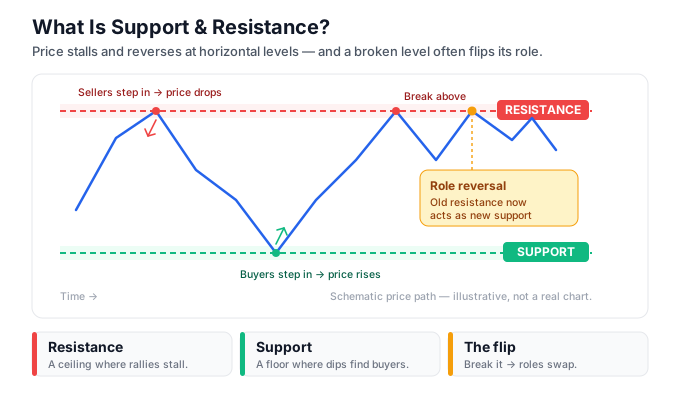
The diagram above shows the two ideas side by side: price bouncing up from a support floor and rejecting down from a resistance ceiling. The rest of this guide explains how these zones form, how to draw them, and how to trade them with defined entry, stop, and target rules. If you have not set up a broker account yet, the full beginner walkthrough covers the steps that come before chart work.
Table of contents
- What is support and resistance?
- Why support and resistance matter
- The types of support and resistance
- How to draw support and resistance on a chart
- How to trade support and resistance
- Support and resistance on XAU/USD (gold)
- Tools that help you mark levels
- Common mistakes traders make
- Support and resistance vs supply and demand
- Frequently asked questions
What is support and resistance?
Support is a price level below the current market where buying pressure has historically been strong enough to stop a decline. When price falls toward support, buyers tend to step in, and the fall slows or reverses.
Resistance is the mirror image: a level above the current market where selling pressure has historically stopped an advance. When price rises into resistance, sellers tend to take control, and the rise stalls or turns down.
These levels are not magic numbers. They reflect memory in the market — where orders clustered before and where stops sit. Price respects them because enough participants act around the same price again and again. The idea sits at the core of forex trading technical analysis.
A key rule: support and resistance are zones, not single lines. Markets rarely turn at the exact pip you drew — a pip is the smallest standard price increment a pair moves, the fourth decimal on most majors (0.0001) and a $0.01 move on gold. Levels hold within a band a few pips wide on majors, thousands of pips (several dollars of price) wide on gold. Treat each level as a range, not a hairline.
Second rule worth memorising early: once a level breaks, it often flips. Broken support frequently becomes new resistance, and broken resistance becomes new support. This “role reversal” is one of the most reliable behaviours on any chart.
Why do support and resistance matter?
Support and resistance give you a framework for the three decisions every trade needs: where to enter, where to put your stop, and where to take profit. Without levels, those decisions are guesses.
The practical benefit is risk definition. A clean resistance level gives you a logical place for a stop on a short — a few pips above the zone. If price closes decisively past it, your thesis is wrong and you exit small. That habit separates traders who survive from traders who blow accounts.
Levels also tell you where NOT to trade. Buying right under thick resistance, or selling right above strong support, means entering where the market is most likely to turn against you. The same level-reading skill applies to EUR/USD on H1, XAU/USD on H4, and a synthetic index on M15.
What are the types of support and resistance?
Not every level is drawn the same way. These are the four kinds you will actually use.
Horizontal levels
Horizontal support and resistance are flat price levels drawn across previous swing highs and swing lows. They are the most common and the easiest to read. A price that reversed at 1.0850 three times is a horizontal resistance level at 1.0850.
Trendlines (diagonal levels)
In a trend, support and resistance angle with the move. An uptrend rides a rising support line drawn under the higher lows; a downtrend rides a falling resistance line drawn over the lower highs. The trendline holds until price closes through it.
Dynamic levels (moving averages)
Moving averages act as support and resistance that move with price. The 50 EMA and 200 EMA are the two most-watched. In a strong uptrend, pullbacks often find support at the 50 EMA on H1 and H4 — useful because the level updates every candle instead of staying fixed.
Pivot points and round numbers
Pivot points are calculated levels derived from the prior session’s high, low, and close. Round numbers (1.1000, 4000.00 on gold) also act as psychological levels because large orders cluster there. Both give you forward-looking levels before price has even tested them. Our pivot point calculator generates the seven standard pivot levels for any session.
How do you draw support and resistance on a chart?
Drawing levels well is a skill, and most traders over-complicate it. Here is the process we use, in order.
Start on the higher timeframe. Open D1 or H4 first. Levels visible on higher timeframes carry more weight than levels you find on M5. Mark the obvious swing highs and lows where price clearly turned.
Connect at least two touches. A level needs a minimum of two reaction points to count. One touch is a coincidence; two is a level; three or more is a strong level. Draw the line through the bodies and wicks where most reactions cluster.
Draw zones, not lines. Stretch each level into a thin rectangle covering the cluster of highs or lows. On EUR/USD H1, a 5-10 pip zone is realistic. On XAU/USD H1, expect a 3,000-5,000 pip zone (a $30-$50 band) because gold overshoots.
Mark role-reversal flips. When you see a level that price broke and then retested from the other side, mark it. These flipped levels are often the cleanest tradeable zones on the chart.
Stop at five or six levels. A chart with 15 lines is useless. Keep only the levels closest to current price and the major higher-timeframe zones. Delete the rest.
The confirmation that you drew a level correctly: price reacts to it again after you marked it. If price slices through your zones as if they are not there, you are drawing noise, not structure.
How do you trade support and resistance?
There are two core approaches: trading the bounce (the reversal off a level) and trading the break (the move through a level). Each needs its own rules.
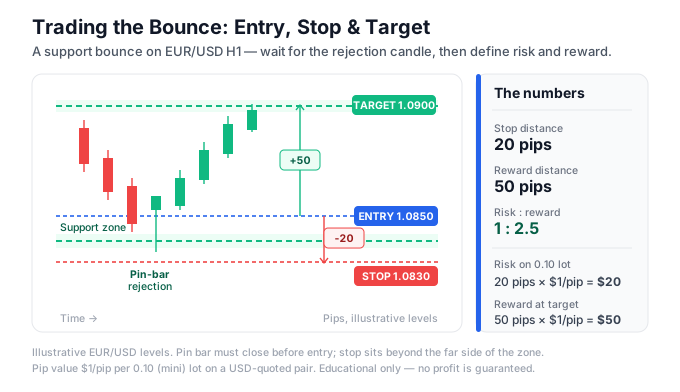
Trading the bounce — entry, stop, target
The setup: price approaches a clearly marked support or resistance zone from an established direction, and you want to trade the reversal.
- Entry trigger: wait for a rejection candle to close inside or slightly past the zone — a bullish engulfing or pin bar at support, a bearish engulfing or pin bar at resistance. Do not enter on the touch alone.
- Confirmation: the rejection candle should close beyond 50% of its range, showing real rejection rather than a weak wick.
- Timeframe: H1 and H4 give the cleanest bounces. M5 reversals fire constantly and most are noise.
- Stop loss: place it a few pips beyond the far side of the zone — below support for a long, above resistance for a short. On EUR/USD H1 that is often a 15-25 pip stop; size it with what is a pip math so a stop in pips becomes a position size.
- Take profit: target the next opposing level. From a support bounce, aim for the nearest resistance above; book partial profit at the first level and trail the rest.
- Risk:reward: skip any bounce that offers less than 1:1.5 to the next level. The reward has to justify the variance.
Trading the break — entry, stop, target
When price closes decisively through a level on strong momentum, the break becomes tradeable in the breakout direction.
- Entry trigger: wait for a candle to CLOSE beyond the zone, not merely poke through it. The cleanest entry is the retest — price breaks, comes back to the flipped level, and rejects in the breakout direction.
- Stop loss: place it on the opposite side of the broken zone. If the retest fails and price re-enters the range, your break was false.
- Take profit: measure the distance of the prior range and project it from the break, or target the next major level.
Most false breakouts happen during low-volume sessions and in the minutes before major news. Waiting for the candle close and the retest filters out a large share of them.
How does support and resistance work on XAU/USD (gold)?
Support and resistance work on gold, but gold demands wider zones and wider stops than forex pairs. XAU/USD routinely overshoots a level by 2,000-4,000 pips (a $20-$40 move) before reversing, so a hairline level gets wicked out even when your read was correct.
- Draw zones 3,000-5,000 pips thick on H1 (a $30-$50 band), not the 5-10 pips you would use on EUR/USD. Gold’s average daily range runs roughly 2,000-5,000 pips (about $20-$50) in 2026, and the noise scales with it.
- Watch round numbers. Whole-hundred levels on gold (4000.00, 4050.00, 4100.00) attract heavy order flow and act as strong psychological support and resistance.
- Respect news. CPI, NFP, and FOMC releases routinely blow gold straight through technical levels. A clean zone means nothing in the first minutes after a high-impact release — stand aside through the spike.
A gold pip is a $0.01 price move — the last decimal of the XAU/USD quote — and a lot is the unit of trade size, with a standard lot equal to 100 ounces. Pip value therefore runs $1 per pip on a standard lot (100 oz), $0.10 per pip on a 0.10 lot (10 oz), and $0.01 per pip on a 0.01 lot (1 oz), so a full $1.00 move in gold is 100 pips, worth $100 on a standard lot. Because gold stops are wider, the same dollar risk forces a smaller lot. A $50 risk (1% of a $5,000 account) with a 2,000-pip gold stop (a $20 move) allows a 0.025 lot position: $1/pip/std lot × 2,000 pips = $2,000 risk per standard lot, and $50 / $2,000 = 0.025 lot.
What tools help you mark levels?
You can trade support and resistance with nothing but the horizontal-line tool, but a few additions speed up the work and add confluence.
- Pivot point indicators — plot session pivots automatically so you have forward-looking levels before the session opens. The pivot point calculator does the math outside the platform.
- Fibonacci retracement — overlays proportional levels (38.2%, 50%, 61.8%) on a swing; these often align with horizontal support and resistance for stacked confluence. Our fibonacci calculator returns the retracement and extension levels for any high-low range.
- Moving averages — the 50 EMA and 200 EMA give you dynamic levels that update each candle.
The strongest setups appear where two of these agree — a horizontal level sitting on a Fibonacci 61.8% retracement, or a pivot level landing on the 200 EMA. Confluence turns an average level into a high-conviction one.
What common mistakes do traders make?
Drawing too many levels. A chart with 15 lines means every move touches something, so nothing is meaningful. Fix: keep five or six levels closest to price and delete the rest.
Treating levels as exact lines. Expecting a turn at the precise pip leads to stops placed too tight, wicked out before the real reversal. Fix: draw zones and place stops beyond the far edge.
Entering on the touch, not the rejection. Buying the instant price tags support often catches a level that is about to break. Fix: wait for a rejection candle to close before entering.
Ignoring the higher timeframe. An H1 resistance level means little if price is ripping through a major D1 support break. Fix: mark D1 and H4 levels first, then trade the lower timeframe inside that context.
Forgetting role reversal. Traders keep treating broken support as support, fighting the new trend. Fix: once a level breaks and price closes through, flip its role on your chart.
Trading levels through news. Support and resistance dissolve in the seconds after CPI or NFP. Fix: check the economic calendar and stand aside through high-impact releases.
Support and resistance vs supply and demand
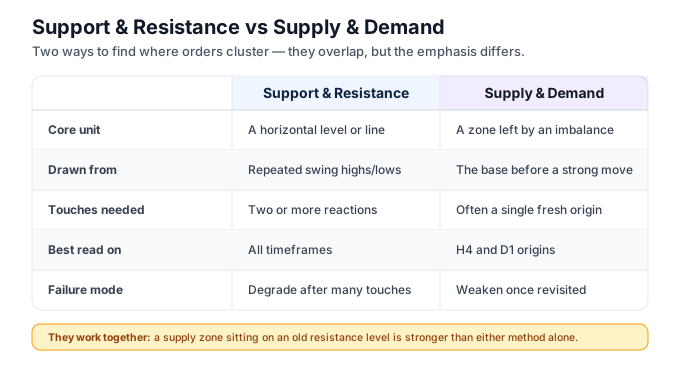
Traders often confuse classic support and resistance with the supply-and-demand approach. They overlap, but the emphasis differs.
| Support and resistance | Supply and demand | |
|---|---|---|
| Core unit | A horizontal level or line | A zone left by an imbalance |
| Drawn from | Repeated swing highs and lows | The base before a strong move |
| Touches needed | Two or more reactions | Often a single fresh origin |
| Best read on | All timeframes | H4 and D1 origins |
| Failure mode | Levels degrade after many touches | Zones weaken once revisited |
In practice the two work together. A supply zone that lines up with a long-standing horizontal resistance level is stronger than either alone. Both methods are trying to find where orders cluster — support and resistance use the visible turning points, supply and demand use the origin of the impulsive move. Most traders learn horizontal levels first because they are simpler to draw, then layer supply and demand once they can read structure cleanly.
Frequently asked questions
How do I draw support and resistance correctly?
Start on D1 or H4, mark the swing highs and lows where price clearly reversed, and connect levels with at least two touches. Draw each as a thin zone rather than a single line, mark any role-reversal flips, and keep only the five or six levels closest to current price. Delete the rest so the chart stays readable.
Does support and resistance work on M5 charts?
It forms on M5, but lower-timeframe levels are weaker and break more often. Spread and noise eat much of the edge on M5, and reversals fire constantly. Use H1 and H4 as your primary timeframes for levels, and only drop to M5 to fine-tune entries inside a higher-timeframe zone you already trust.
What’s the difference between support and resistance and supply and demand?
Support and resistance are horizontal levels drawn from repeated swing highs and lows. Supply and demand are zones drawn from the base of a strong impulsive move, often from a single fresh origin. They overlap heavily — a supply zone sitting on an old resistance level is stronger than either alone — but support and resistance is the simpler method to learn first.
Does support and resistance apply to gold (XAU/USD)?
Yes, but draw wider zones. Gold overshoots levels by 2,000-4,000 pips (a $20-$40 move) before reversing, so use 3,000-5,000 pip zones on H1 instead of the 5-10 pips you would use on EUR/USD. (A gold pip is a $0.01 move, so $1 of price equals 100 pips.) Round numbers like 4000.00 act as strong psychological levels, and high-impact news (CPI, NFP, FOMC) routinely blows gold straight through technical levels.
Why does price keep breaking my support and resistance levels?
Usually one of three reasons: you drew too many levels so price touches noise, you used exact lines instead of zones, or you ignored the higher-timeframe trend. Strong trends slice through counter-trend levels. Mark D1 and H4 first, draw zones with at least two touches, and trade in the direction of the higher-timeframe structure.
Can I trade support and resistance without indicators?
Yes. Support and resistance is a pure price-action concept — the horizontal-line tool is all you strictly need. Indicators like pivot points, Fibonacci retracement, and moving averages add confluence and forward-looking levels, but they confirm what the price chart already shows. Many traders read levels by eye and add tools only to speed up marking.
What’s a good stop-loss placement when trading a level?
Place the stop beyond the far side of the zone, not at the exact level. For a long off support, the stop sits below the support zone; for a short at resistance, above the resistance zone. On EUR/USD H1 that is often 15-25 pips. On gold, plan for 1,500-2,500 pips (a $15-$25 move, since a gold pip is $0.01) because of the wider noise, and size the position down accordingly.
Related reading
- Support and Resistance Trading Strategy: A Complete System
- Fibonacci Retracement Trading Strategy
- Pivot Point Calculator
- Forex order types explained
Risk disclaimer: Forex and CFD trading carries a high level of risk and may not be suitable for all traders. The strategies and indicators described in this article are educational. Past performance does not guarantee future results. Always test on a demo account before risking real capital.