


Last updated: June 30, 2026 · By: Tim Morris, founder of ForexMT4Indicators.com
Going long means buying a currency pair because you expect its price to rise, then selling higher to profit. Going short means selling a pair first because you expect its price to fall, then buying it back lower. Long profits when price rises; short profits when price falls.
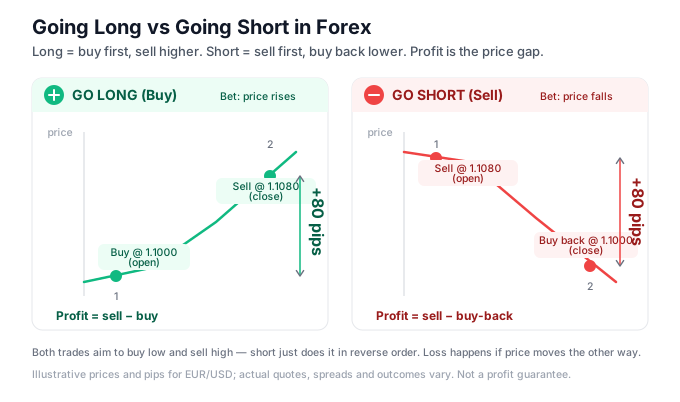
The diagram above shows both trades side by side: long buys low then sells higher, while short sells high then buys back lower. In each case your profit is the gap between the two prices. This guide explains when to go long, when to go short, how short selling works without owning anything, and the mistakes that cost beginners money.
Table of contents
- What does going long vs going short mean?
- Why direction matters in forex trading
- How going long works
- How going short works
- How to decide which direction to trade
- Going long vs going short on XAU/USD (gold)
- Common mistakes traders make with long and short
- Long vs short — side-by-side comparison
- Frequently asked questions
What does going long vs going short mean?
Going long and going short describe the two directions you can bet on in forex. They are the only two ways to open a position, and every trade you place is one or the other.
A long position is a buy. You open it at the ask price expecting the pair to rise, then close it by selling at the bid. Your profit is the difference between your higher exit and your lower entry, minus costs.
A short position is a sell. You open it by selling first at the bid, then close it by buying back at the ask. Your profit is the difference between your higher entry and your lower exit.
The terms come from older markets, but the logic is the same everywhere: “long” points up, “short” points down. In forex you can short any pair as easily as you can buy it.
Why direction matters in forex trading
Choosing long or short is the first decision in every trade, before stop, target, or position size — and if you have not placed one yet, a 7-step walkthrough covers how to start forex trading the right way. Get the direction wrong and no risk management saves the trade.
Forex makes both directions equally available. When you buy EUR/USD you are long the euro and short the dollar at the same time, because a currency pair is a ratio of two values. Selling EUR/USD flips that — you are short the euro and long the dollar.
This symmetry is the practical edge of currency trading. In a stock account, shorting is restricted, needs borrowing, and can be banned during a crash. In forex, falling markets are as tradeable as rising ones, so a strong downtrend on GBP/JPY is an opportunity, not a problem. It also clarifies your real exposure — a trader long three USD pairs is heavily betting against the dollar, even if the charts look unrelated.
How going long works
A long trade matches everyday intuition: buy something cheap, sell it dearer. You click buy, and the platform fills you at the ask price. Say you go long EUR/USD at 1.1000 with a 0.10 lot — the position now gains as price rises and loses as price falls.
If price climbs to 1.1080 and you close, you sold 80 pips higher than you bought. At $1 per pip on a 0.10 mini lot, that is an $80 gross profit before spread. A pip is 0.0001 on most pairs, so 1.1080 minus 1.1000 is exactly 80 pips.
Your downside on a long is defined by your stop. If the same trade fell to 1.0960, that is 40 pips against you, or $40 on the 0.10 lot. A long can only lose what price falls before you exit, which is why a stop loss is non-negotiable.
A long opens at the ask and closes at the bid, so the spread works against you on entry. That is why a fresh long shows a small floating loss the instant it opens — price must clear the spread before break-even.
How going short works
Short selling confuses beginners because you sell something before you own it. In forex this is normal and built into every platform — you are not borrowing physical currency, you are taking a contract that profits when price drops.
You click sell, and the platform fills you at the bid price. Say you go short EUR/USD at 1.1080 with a 0.10 lot — the position now gains as price falls and loses as price rises, the mirror image of a long.
If price drops to 1.1000 and you buy back to close, you bought 80 pips lower than you sold. That is the same $80 gross profit as the long example, earned in the opposite direction. The order of the two trades is reversed; the maths is identical.
Your risk on a short is that price rises instead. If EUR/USD climbed to 1.1120 against your short, that is 40 pips of loss, or $40 on the 0.10 lot. Because price can keep rising, a short without a stop has open-ended risk, so the stop matters more than on a long.
A short opens at the bid and closes at the ask, so the spread again costs you on entry — whether long or short, you pay it once on the way in. To choose the exact order that opens a short, a market sell or a pending sell stop, see our guide to forex order types.
How to decide which direction to trade
Direction is a read on the market, not a coin flip. The cleanest approach is to align your trade with the prevailing trend on a higher timeframe and enter on a pullback.
Trade long when structure is rising: higher highs and higher lows on the H4 or D1, price holding above a key moving average, and momentum pushing up all argue for buying pullbacks rather than fading them.
Trade short when structure is falling: lower highs and lower lows, price pinned below the moving average, and momentum rolling over argue for selling rallies. Most traders who lose money are buying a falling market because it “looks cheap.”
Avoid trading direction inside a tight range. When price chops sideways between support and resistance, both long and short signals fire and fail repeatedly. Either wait for a breakout or trade the range edges with tight risk.
Match direction to the session too. A clean London-session trend on EUR/USD beats a directional bet during the quiet late Asian session, when thin liquidity fakes moves in both directions.
Going long vs going short on XAU/USD (gold)
Gold is the most-traded instrument among our readers in 2026, and you can go long or short it exactly as you do a currency pair. The direction logic is the same, but the numbers and behaviour differ enough to treat gold as its own case.
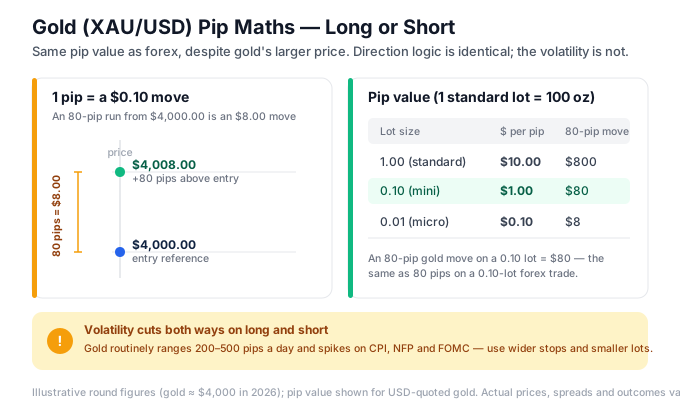
Gold pip maths is distinct. On XAU/USD a pip is a $0.01 price move, a standard lot is 100 ounces, and the pip value is $1 per pip per standard lot, $0.10 per pip per 0.10 lot, and $0.01 per pip per 0.01 lot. With gold near $4,000 in 2026, a move from $4,000.00 to $4,008.00 is $8.00 — 800 pips — worth $80 on a 0.10 lot.
Both directions carry gold’s extra volatility. XAU/USD routinely ranges $20 to $50 a day (about 2,000 to 5,000 pips) and spikes hard around CPI, NFP, and FOMC, so a short caught on the wrong side of a gold spike moves against you faster than the same mistake on EUR/USD.
Size and stops must respect that range whether you are long or short. Forex-sized stops get wicked out on gold; plan for wider stops and smaller lots so a normal gold wick does not stop you out of a correct directional call. Our position size calculator sizes the lot for you once you set the stop in pips.
Common mistakes traders make with long and short
Only ever going long. Many beginners never short because selling first feels unnatural, so they sit out every downtrend. Fix: practise short setups on a demo until the mechanics feel as routine as buying.
Buying a falling market because it “looks cheap.” Price has no memory of being higher; a downtrend can fall much further. Fix: trade with the higher-timeframe structure, not against it — short weakness, do not buy it.
Shorting without a stop. A short’s risk is open-ended because price can keep rising indefinitely. Fix: always set a stop above the recent swing high the moment you open a short.
Forgetting the overnight swap. Holding a position past rollover charges or pays interest, and the cost depends on your direction. Fix: check the swap on the pair and direction before holding overnight, especially on negative-carry trades.
Confusing which currency you are betting on. Going long EUR/USD is also a bet against the dollar, which stacks risk if you hold other USD trades. Fix: map your real exposure across all open positions, not pair by pair.
Reversing direction on every wiggle. Flipping from long to short and back on noise pays the spread each time and shreds the account. Fix: set your direction from structure before the session and hold it unless structure actually breaks.
Long vs short — side-by-side comparison
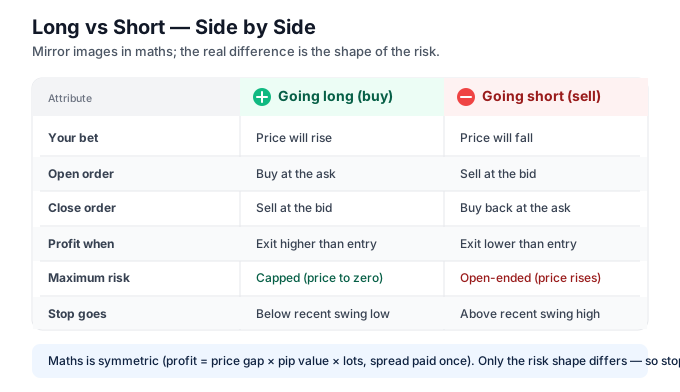
Long and short are mirror images, but the differences in order flow and risk shape matter in practice. The table settles them at a glance.
| Going long (buy) | Going short (sell) | |
|---|---|---|
| Your bet | Price will rise | Price will fall |
| Open order | Buy at the ask | Sell at the bid |
| Close order | Sell at the bid | Buy back at the ask |
| Profit when | Exit higher than entry | Exit lower than entry |
| Maximum risk | Limited to price falling to zero | Open-ended as price rises |
| Stop goes | Below the recent swing low | Above the recent swing high |
The core maths is symmetric: in both cases profit equals the price gap times pip value times lots, and you pay the spread once on entry. The asymmetry is in risk shape — a long can only fall to zero, while a short’s loss grows without a fixed ceiling, so disciplined stops matter most on the short side.
Once you accept that selling first is only a contract that profits on a decline, going short becomes as routine as going long.
Frequently asked questions
What does going long and going short mean in forex?
Going long means buying a currency pair because you expect its price to rise, then selling higher to profit. Going short means selling first because you expect it to fall, then buying it back lower. Long profits from rising prices; short profits from falling prices. Every forex trade is one of these two directions.
Can you actually short sell in forex?
Yes, and it is simple. Every forex pair can be sold first and bought back later, with no borrowing or special permission, because you trade a contract on price rather than owning the currency. This is a major advantage over stock accounts, where shorting is restricted. In forex, falling markets are as tradeable as rising ones.
Is going long safer than going short?
Slightly, in one narrow sense: a long’s loss is capped because price can only fall to zero, while a short’s loss is open-ended because price can keep rising. In practice both are equally safe or dangerous depending on your stop. A short with a disciplined stop is as controlled as any long.
Do I pay the spread on both long and short trades?
Yes. A long opens at the ask and closes at the bid; a short opens at the bid and closes at the ask. Either way you cross the bid-ask gap once on entry, so the spread is unavoidable on both directions. That is why every fresh trade shows a small floating loss the moment it opens.
Does going short cost more to hold overnight?
It depends on the interest-rate differential. Holding past the daily rollover charges or pays a swap based on the two currencies and your direction. Shorting a high-interest currency against a low-interest one often costs more overnight, while the opposite direction may pay you. Always check the swap before holding overnight.
Related reading
Risk disclaimer: Forex and CFD trading carries a high level of risk and may not be suitable for all traders. The strategies and indicators described in this article are educational. Past performance does not guarantee future results. Always test on a demo account before risking real capital.
Ready to put this into practice?
Open an account with a regulated broker and apply what you have learned. These are the three brokers we recommend:
Trading forex and CFDs carries a significant risk of loss and is not suitable for everyone. Broker links are affiliate links — we may earn a commission at no cost to you.