


Last updated: June 30, 2026 · By: Tim Morris, founder of ForexMT4Indicators.com
Forex trading is the buying and selling of one currency against another to profit from changes in their exchange rate. You always trade in pairs, such as EUR/USD, betting that one currency will strengthen or weaken versus the other. It is the largest financial market in the world, with roughly $9.6 trillion traded daily.
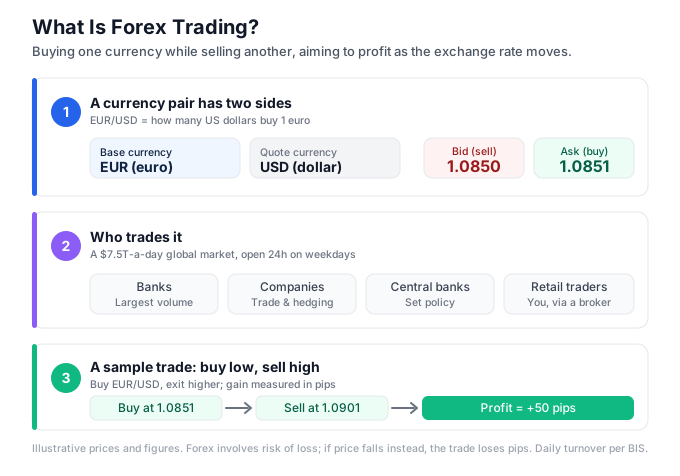
This guide explains how the forex market works, how a single trade is structured, and the core mechanics — pips, lots, leverage, spreads, and margin — that decide whether your account survives. It is written for someone with a small account who wants the honest version, not the get-rich pitch. The hero diagram in this guide traces the full path of one EUR/USD trade, from quote to profit or loss.
Table of contents
- What is forex trading?
- Who trades forex and why the market exists
- How a forex trade actually works
- What is a currency pair?
- What is a pip?
- What is a lot size?
- What is leverage and margin?
- What is the spread?
- How to read a forex quote
- The two ways traders analyze the market
- How much money do you need to start?
- Common beginner mistakes
- Forex trading vs stocks and crypto
- Trading gold (XAU/USD) as a beginner
- Forex and prop firm challenges
- A recommended learning path
- Frequently asked questions
- Glossary
What is forex trading?
Forex (foreign exchange, also called FX) is the global market where currencies are traded against each other. The word “forex” combines “foreign” and “exchange.” Every trade involves swapping one currency for another at the current market price.
You never trade a currency in isolation. You trade a pair. When you “buy EUR/USD,” you are buying euros and selling US dollars in the same action. Your profit or loss comes from how the euro moves relative to the dollar.
A retail trader does not take delivery of physical currency. Most forex trading is done as a Contract for Difference (CFD), a derivative where you trade the price difference without owning the underlying currency. This is why you can open and close a position in seconds.
The market runs 24 hours a day, five days a week. It opens Monday morning in Sydney and closes Friday evening in New York, passing through the Asian, London, and New York sessions as the trading day moves around the globe. The exact session open and close times in GMT shift by one hour when the relevant region moves on or off daylight saving time, so check your broker’s server clock rather than memorising a fixed GMT time.
Forex is the most liquid market on the planet. The Bank for International Settlements measured daily turnover at around $9.6 trillion in its April 2025 Triennial Survey, its most recent. That depth is why major pairs like EUR/USD have tight spreads — the small gap between the buy and sell price that you pay to enter — and rarely gap during normal hours.
Who trades forex and why the market exists
The forex market did not exist to give retail traders a way to speculate. It exists because global commerce needs currency conversion. A company in Indonesia buying machinery from Germany has to convert rupiah into euros, and that conversion happens in the forex market.
Banks are the largest players. They quote prices to each other in the interbank market and provide the liquidity that everyone else draws on. Central banks intervene to manage their currencies and set interest rates that move exchange rates.
Corporations hedge currency risk. An exporter who will receive dollars in three months can lock in a rate today to protect against the dollar falling. This hedging flow is constant and price-insensitive, which adds stability.
Retail traders — people like you — are a small slice of total volume but a large slice of the accounts. You access the market through a broker, who routes your orders to liquidity providers or takes the other side internally. Your edge, if you have one, comes from discipline and risk control, not from outsmarting the banks.
How a forex trade actually works
A forex trade has a direction, a size, and an exit plan. Get those three right and the mechanics take care of themselves. Get them wrong and no indicator will save you.
Direction is simple. You go long (buy) if you expect the base currency to strengthen, or short (sell) if you expect it to weaken. Forex lets you short as easily as you go long, because every buy of one currency is automatically a sell of the other.
Size is set by your lot size — a lot being the standardized quantity of currency in a trade — which we cover below. Size determines how much each pip of movement is worth in your account currency, a pip being the standard unit of price movement (0.0001 on most pairs). A larger lot means larger profit per pip — and larger loss per pip.
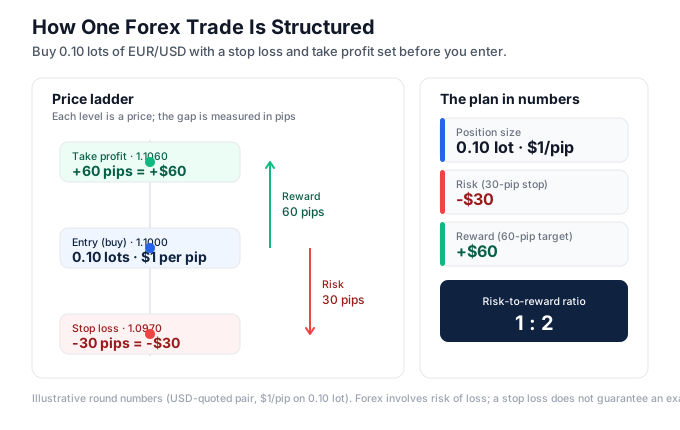
Your exit plan is two orders: a stop loss that closes the trade if price moves against you by a set amount, and a take profit that closes it once your target is hit. Placing both before you enter removes emotion from the decision.
Here is a full example with round numbers. You buy 0.10 lots of EUR/USD at 1.1000 with a 30-pip stop loss and a 60-pip take profit. Each pip is worth $1 on a 0.10 lot, so your risk is $30 and your reward is $60 — a risk-to-reward ratio of 1:2.
If price rises to 1.1060, your take profit triggers and you book $60. If it drops to 1.0970, your stop triggers and you lose $30. You did not need to watch the screen; the orders did the work.
What is a currency pair?
A currency pair quotes two currencies together: a base currency and a quote currency. In EUR/USD, the euro is the base and the dollar is the quote. The price tells you how many units of the quote currency buy one unit of the base.
When EUR/USD trades at 1.1000, one euro costs 1.1000 US dollars. If the price rises to 1.1050, the euro has strengthened against the dollar. If it falls to 1.0950, the euro has weakened.
Pairs fall into three groups by liquidity and spread.
- Majors — pairs that include the US dollar against another large economy: EUR/USD, GBP/USD, USD/JPY, USD/CHF, USD/CAD, AUD/USD, NZD/USD. Tightest spreads, deepest liquidity.
- Minors (crosses) — pairs without the US dollar, like EUR/GBP or AUD/JPY. Wider spreads, still tradeable.
- Exotics — a major against an emerging-market currency, such as USD/ZAR or USD/TRY. Wide spreads, sharp moves, higher cost.
Beginners should start on a major. EUR/USD has the tightest spread, the most predictable behavior, and the most educational material available. Trade it on H1 or H4 while you learn, where each candle gives you time to think.
What is a pip?
A pip is the standard unit of price movement in forex. For most pairs, 1 pip = 0.0001, the fourth decimal place. For pairs that include the Japanese yen, 1 pip = 0.01, the second decimal place, because yen prices are quoted with fewer decimals.
If EUR/USD moves from 1.1000 to 1.1001, that is 1 pip. A move from 1.1000 to 1.1050 is 50 pips. On USD/JPY, a move from 157.00 to 157.50 is also 50 pips, measured at the second decimal.
Many brokers quote a fifth decimal (or third on yen pairs). That extra digit is a pipette, one-tenth of a pip. A price of 1.10005 is half a pip above 1.1000. The pipette gives finer pricing; it does not change how you count pips.
Pips matter because they are how you measure both profit and risk. Your stop loss is a pip distance, your target is a pip distance, and the spread you pay is a pip cost.
Once you think in pips, the dollar amounts follow from your lot size. For a deeper breakdown, read our full guide on what is a pip.
What is a lot size?
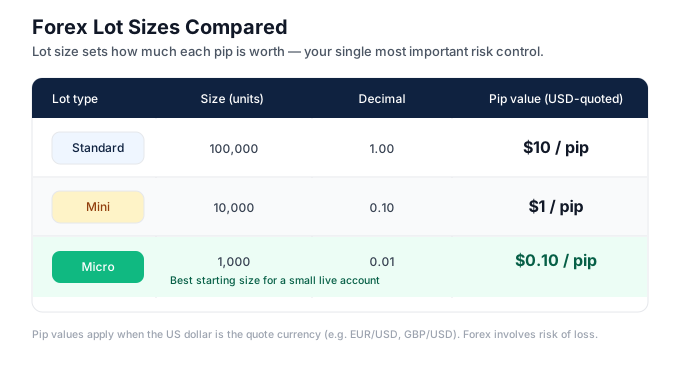
A lot is the standardized quantity of currency in a trade. Lot size decides how much money each pip is worth, which makes it the single most important risk control you have.
There are three common lot sizes:
| Lot type | Size (units) | Decimal | Pip value (USD-quoted pair) |
|---|---|---|---|
| Standard | 100,000 | 1.00 | $10 per pip |
| Mini | 10,000 | 0.10 | $1 per pip |
| Micro | 1,000 | 0.01 | $0.10 per pip |
The pip values of $10 (standard lot), $1 (mini lot), and $0.10 (micro lot) apply when the US dollar is the quote currency, as in EUR/USD or GBP/USD. A standard lot of EUR/USD earns or loses $10 for every pip. A micro lot earns or loses $0.10 per pip — the right starting size for a small live account.
Position size is not a guess. It is calculated from three inputs: your account size, the percentage you are willing to risk, and your stop-loss distance in pips. The formula is straightforward.
Position size (lots) = (account risk in dollars) ÷ (stop in pips × pip value per lot).
Suppose you have a $1,000 account and risk 1% ($10) on a trade with a 20-pip stop. On a micro lot, each pip is worth $0.10, so 20 pips of risk costs $2 per micro lot. Dividing $10 by $2 gives 5 micro lots, or 0.05 lots. Our lot size calculator does this math for you, and the pip value calculator confirms the per-pip figure for any pair.
What is leverage and margin?
Leverage lets you control a position larger than your account balance. Margin is the deposit the broker sets aside to hold that position. They are two sides of the same mechanism, and misusing them is the fastest way to blow an account.
Leverage is expressed as a ratio. At 1:100, every $1 of margin controls $100 of position. At 1:500, every $1 controls $500. The margin requirement is the notional position size — the full market value of the position you control, not just your deposit — divided by the leverage.
The math is exact. A standard lot of EUR/USD has a notional value near $110,000 at a price of 1.1000. At 1:100 leverage, the required margin is the notional divided by 100 — about $1,100, which is 1% of the position. At 1:500, margin is the notional divided by 500 — about $220, or 0.2% of the position.
Higher leverage does not increase your profit per pip. A pip is worth the same $10 on a standard lot whether your leverage is 1:100 or 1:500. What leverage changes is how large a position your deposit can open — and therefore how fast a losing run can wipe you out.
This is the trap that catches beginners. High leverage feels like buying power. It is actually a measure of how little cushion sits between you and a margin call, the point where the broker closes your positions because equity has fallen below the margin requirement. Read our full explainer on leverage before you raise it.
The fix is to size positions by risk, not by available margin. If your risk math says 0.05 lots, trade 0.05 lots — even if your leverage would let you open 5.00. Leverage sets the ceiling; your risk rule sets the trade.
What is the spread?
The spread is the difference between the price you can buy at (the Ask) and the price you can sell at (the Bid). It is the broker’s built-in fee and the cost you pay the instant you enter a trade. Spread = Ask − Bid.
If EUR/USD shows a Bid of 1.10000 and an Ask of 1.10010, the spread is 1 pip. You buy at the higher Ask and, if you sold immediately, you would sell at the lower Bid — starting the trade 1 pip in the red before price moves at all.
The dollar cost of the spread is simple to work out: spread (in pips) × pip value × number of lots. A 1-pip spread on a 0.10 lot of EUR/USD costs $1 to enter. The same 1-pip spread on a 1.00 standard lot costs $10.
Spreads widen during low-liquidity hours and around high-impact news. The quiet end of the Asian session and the seconds around an NFP release both push spreads up. Scalpers feel this most, because spread is a larger share of a small target. Our guide on the spread covers how to keep this cost low.
How to read a forex quote
A forex quote always shows two prices and two terms. Once you can read it, the rest of the platform makes sense.
The two prices are the Bid and the Ask. The Bid is the lower number, the price at which you sell. The Ask is the higher number, the price at which you buy. The gap between them is the spread.
The two terms are the base and quote currency, fixed by the pair. EUR/USD at “1.10000 / 1.10012” means you sell euros at 1.10000 dollars each and buy them at 1.10012 dollars each.
A common beginner error is buying at the Bid in your head and being surprised the trade opens slightly worse. You always enter at the Ask when buying and the Bid when selling. That difference is the spread you paid on entry.
The two ways traders analyze the market
Traders decide direction using two broad approaches. Most experienced traders blend them rather than treating either as gospel.
Technical analysis
Technical analysis studies price itself — charts, candles, and indicators — on the assumption that price already reflects all known information. A technical trader looks for trends, levels, and patterns that have tended to repeat.
The most useful starting concept is support and resistance: price floors where buyers have stepped in before, and ceilings where sellers have. These zones give you reference points for entries, stops, and targets without any indicator at all.
Indicators come next. Moving averages show trend direction, the RSI (Relative Strength Index) shows momentum, and the ATR (Average True Range) shows volatility for stop placement. Treat indicators as confirmation, not as triggers that fire trades on their own.
Fundamental analysis
Fundamental analysis studies the forces behind a currency: interest rates, inflation, growth, and employment. A central bank raising rates tends to strengthen its currency; weak data tends to weaken it.
You do not need an economics degree to use it. Knowing when high-impact events release — NFP, CPI, and central bank decisions — is enough to avoid being caught on the wrong side of a sudden move. Check an economic calendar before every trading session.
How much money do you need to start?
You can open a live forex account with as little as $10 at some brokers, but the honest answer is that capital is not the first thing that decides whether you succeed. Risk control and a tested process matter more than balance.
Start on a demo account. A demo gives you real-time prices with virtual money, so you can learn the platform, place orders, and test a method without losing anything. Spend at least one to three months on demo before you fund a live account.
When you do go live, start small — $100 to $500 is enough to learn the emotional side of trading that demo cannot teach. Trade micro lots, where each pip on a USD-quoted pair is worth $0.10, so a 20-pip loss costs $2. The goal at this stage is survival and consistency, not income.
Be realistic about returns. Most retail traders lose money in their first years; broker risk disclosures across regulated jurisdictions routinely show that the majority of retail CFD accounts lose. Treat your first capital as tuition. The traders who last are the ones who protect their capital long enough to learn.
Common beginner mistakes
Most blown accounts fail for the same handful of reasons. Each one has a specific fix.
1. Risking too much per trade
Beginners often risk 10% or more on a single trade, so a short losing streak ends the account. Fix: risk a fixed small percentage — 1% is the standard — so a run of losses is survivable.
2. Confusing leverage with buying power
High leverage tempts traders to open positions far larger than their risk math allows. Fix: size every trade from your stop distance and risk percentage, and ignore how large a position your margin would technically permit.
3. Trading without a stop loss
Holding a losing trade “until it comes back” turns a small loss into a margin call. Fix: place a stop loss on every trade before you enter, and never widen it once price is moving against you.
4. Overtrading
Taking trade after trade out of boredom or revenge bleeds the account through spread and bad entries. Fix: define what a valid setup looks like and pass on everything that does not match it.
5. Ignoring the economic calendar
Entering a tight scalp seconds before an NFP release invites a violent spike through your stop. Fix: check the calendar before each session and stand aside around high-impact events until you understand them.
6. Jumping to live too soon
New traders fund a live account before they can trade demo profitably, then learn expensive lessons with real money. Fix: demo for one to three months and only go live once your process is consistent.
Forex trading vs stocks and crypto
Forex is not the only market, and it suits different traders for different reasons. Here is how it compares with the two markets beginners most often weigh against it.
Forex vs stocks
Forex trades 24 hours a day on weekdays; stock exchanges have fixed hours. Forex focuses on a few dozen liquid pairs, while stocks span thousands of companies. Forex spreads on majors are tight, and you can go short as easily as long, which is harder with many stock accounts.
Stocks give you ownership and, sometimes, dividends. Forex gives you flexibility, liquidity, and lower starting capital. Neither is safer by default — risk comes from position size and leverage, not from the market name.
Forex vs crypto
Crypto trades 24/7, including weekends, and is far more volatile than major forex pairs. That volatility cuts both ways: larger moves mean larger profit potential and larger, faster losses.
Forex majors are more stable and more liquid, with central banks and economic data providing a logic you can study. Many traders use the same charting skills across both. If you are starting out, the steadier behavior of a major forex pair is an easier place to learn.
Trading gold (XAU/USD) as a beginner
Gold, quoted as XAU/USD, is among the most popular instruments with retail traders in 2026. It trades on the same platforms as forex and uses the same order types, but it behaves differently enough that you should treat it as its own instrument.
Gold’s pip is defined differently from a forex pair. For XAU/USD, 1 pip is a $0.01 price move — the last decimal of the quote — so a standard lot (100 oz) is worth $1.00 per pip, a 0.10 lot (10 oz) $0.10 per pip, and a 0.01 lot (1 oz) $0.01 per pip. That means a full $1.00 move in gold equals 100 pips, or $100 on a standard lot. What also changes is how far price moves. XAU/USD routinely covers $20 to $50 in a single day — roughly 2,000 to 5,000 pips at $0.01 each — several times the daily range of EUR/USD.
That range demands wider stops. A 20-pip ($0.20) stop that is reasonable on EUR/USD H1 gets wicked out almost instantly on gold, where a single normal H1 candle can swing several dollars — hundreds of pips at $0.01 each. Most traders use volatility-based stops on gold and accept a smaller position size to keep dollar risk the same.
Gold also reacts sharply to US data and real yields. CPI, NFP, and FOMC decisions can move it several dollars — hundreds of pips — in seconds, and spreads widen hard during those windows. For a beginner, the lesson is simple: trade gold smaller than you think you should, and stay flat around high-impact news until you have screen time with how it spikes.
Forex and prop firm challenges
A growing number of new traders skip the slow path of building a small account and instead attempt a prop firm challenge. A proprietary trading firm gives you a funded account if you can pass an evaluation, then splits the profits with you.
The evaluation has rules built around risk. A typical challenge sets a profit target near 8% to 10%, a daily loss limit around 5%, and a maximum drawdown around 10%. Break a limit and the account fails, regardless of how the trade would have turned out.
These rules reward exactly the habits this guide pushes: small per-trade risk, stops on every trade, and no oversized positions. A trader risking 1% per trade has room to be wrong several times without touching the daily limit. A trader risking 5% per trade can breach a ~5% daily loss limit on a single bad trade — and the ~10% total drawdown after just two — which is why 5% per trade is unsafe under these rules.
Prop firms are not a shortcut around skill. They are a different funding model for traders who already have a tested, disciplined process. Learn the mechanics on your own small account first; the challenge tests whether you can follow rules under pressure, not whether you can learn from scratch.
A recommended learning path
Forex has a logical order to learn it in. Following one builds each concept on the last instead of leaving gaps.
- Master the mechanics — pips, lots, leverage, margin, and spread. Re-read the sections above until the example trade makes complete sense.
- Understand cost and risk — confirm you can calculate position size and the dollar cost of the spread for any trade. Use the free forex tools to check your math.
- Learn to read price — start with support and resistance before any indicator. It is the foundation everything else sits on.
- Add one or two indicators — a moving average for trend and the RSI for momentum is plenty. Resist the urge to stack ten tools on one chart.
- Build a simple plan — one pair, one timeframe (H1 or H4), one setup, fixed 1% risk, stop and target on every trade.
- Demo for one to three months — trade your plan until it is consistent and boring before you risk real capital.
- Go live small — micro lots, $100 to $500, with the only goal being to follow your plan exactly.
The traders who reach consistency are rarely the ones who learned the most exotic strategy. They are the ones who got the mechanics and the risk control right and then repeated a simple process without breaking their own rules.
Frequently asked questions
What is forex trading in simple words?
Forex trading is exchanging one currency for another to profit from changes in their exchange rate. You trade in pairs, like EUR/USD, going long if you think the first currency will rise against the second, or short if you think it will fall. It is the world’s largest market, trading around $9.6 trillion daily.
How much money do I need to start forex trading?
Some brokers let you open a live account with as little as $10, but $100 to $500 is a more practical starting point once you have traded demo for one to three months. Trade micro lots so each pip on a USD-quoted pair costs $0.10. Your early goal is survival and consistency, not income.
Can I make a living from forex trading?
It is possible but rare and slow. Most retail traders lose money in their first years, and regulated broker disclosures show the majority of retail CFD accounts lose. Earning a living needs sufficient capital, a tested edge, and strict risk control built over years — not a single strategy or indicator.
How long does it take to become profitable in forex?
For most traders, consistent profitability takes one to three years of deliberate practice, not weeks. The mechanics take days to learn, but the discipline to follow a plan under pressure takes far longer. Demo trade for one to three months first, then go live small while you build that discipline.
What is the difference between a pip and a lot?
A pip is the unit of price movement — 0.0001 on most pairs, 0.01 on yen pairs. A lot is the size of your position, which sets how much each pip is worth in money. A standard lot makes each pip worth $10 on a USD-quoted pair; a micro lot makes it worth $0.10.
Is forex trading good for beginners?
Forex can suit beginners because of low starting capital, 24-hour access, and tight spreads on major pairs. It is also where many beginners lose money fast through overleverage and no risk control. Start on a major pair, demo first, risk 1% per trade, and treat your first live capital as tuition.
Does forex trading work for XAU/USD (gold)?
Yes. Gold trades on the same platforms with the same order types, but its pip is a $0.01 move, so a standard lot (100 oz) is worth $1.00 per pip, a 0.10 lot $0.10, and a 0.01 lot $0.01. The difference is range: XAU/USD moves $20 to $50 a day — roughly 2,000 to 5,000 pips — and needs wider stops and smaller positions than EUR/USD. Trade gold smaller and stay flat around high-impact news.
Is forex trading safe?
Forex trading is legitimate but carries real risk, and most retail traders lose money — regulated broker disclosures show the majority of CFD accounts lose. It is safer when you trade with a regulated broker, risk only 1% per trade, use a stop loss, and start on a demo account.
Is forex trading legal?
Yes, forex trading is legal in most countries, including the US, UK, EU, and Australia, though rules differ. Many regulators cap leverage and require risk warnings, and some restrict CFDs. Always trade through a broker licensed by a recognised regulator such as the FCA, ASIC, or CFTC, and check local rules first.
Is forex trading a scam?
Forex trading itself is not a scam — it is a regulated, multi-trillion-dollar market. But scams exist around it: fake signal sellers, guaranteed-profit schemes, and unregulated brokers. Be wary of anyone promising fixed returns, verify a broker’s regulatory licence, and remember that legitimate trading carries risk and never guarantees profit.
Glossary
- Forex (FX) — the global market for trading currencies against each other; around $9.6 trillion in daily turnover.
- Currency pair — two currencies quoted together; the first is the base, the second is the quote currency.
- Base currency — the first currency in a pair; the price says how much quote currency buys one unit of it.
- Quote currency — the second currency in a pair; the pair’s price is expressed in this currency.
- Pip — the standard unit of price movement; 0.0001 on most pairs, 0.01 on yen pairs. See what is a pip.
- Pipette — one-tenth of a pip; the fifth decimal on most pairs, third on yen pairs.
- Lot — the standardized trade size: standard (100,000 units), mini (10,000), micro (1,000).
- Leverage — a ratio that lets a small margin control a larger position; 1:100 means $1 controls $100. See leverage.
- Margin — the deposit a broker holds to keep a leveraged position open; margin = notional ÷ leverage.
- Spread — the gap between Bid and Ask; the cost of entering a trade. See the spread.
- Bid — the price you sell at; the lower of the two quoted prices.
- Ask — the price you buy at; the higher of the two quoted prices.
- Stop loss — an order that closes a losing trade at a set price to cap the loss.
- Take profit — an order that closes a winning trade once it reaches your target.
- Margin call — when equity falls below the margin requirement and the broker closes positions.
- CFD — Contract for Difference; a derivative letting you trade price changes without owning the currency.
- XAU/USD — the symbol for spot gold quoted in US dollars.
Risk disclaimer: Forex and CFD trading carries a high level of risk and may not be suitable for all traders. The strategies and concepts described in this article are educational. Past performance does not guarantee future results. Always test on a demo account before risking real capital.
Related guides
Ready to begin? Follow our step-by-step guide on how to start forex trading.