


Last updated: June 30, 2026 · By: Tim Morris, founder of ForexMt4Indicators.com
A currency pair quotes one currency against another. The first currency is the base, the second is the quote. EUR/USD at 1.0850 means 1 euro buys 1.0850 US dollars. Pairs split into three groups: majors (always include USD), minors or crosses (major against major, no USD), and exotics (a major against an emerging-market currency).
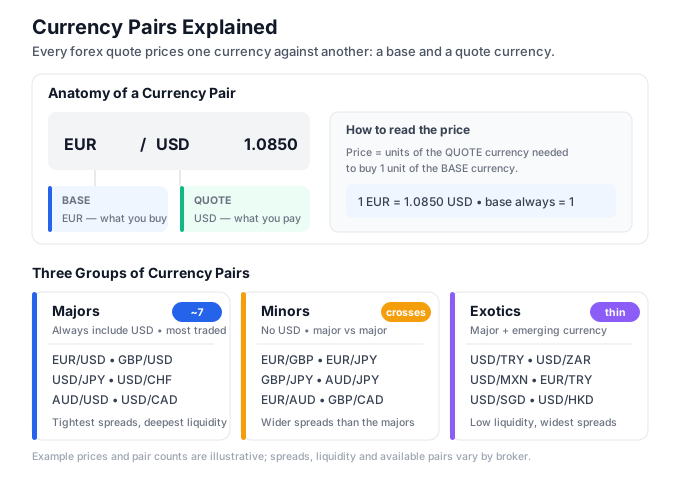
The diagram above splits a quote into its two halves and groups the pairs you will see in your platform. The rest of this guide turns that picture into rules you can use when you place a trade.
If you are still mapping out the basics, our forex trading guide covers how the whole market fits together; this article zooms in on the pairs themselves.
What is a currency pair
A currency pair is two currencies quoted as a single price. You never buy one currency in isolation — you always exchange one for another, which is why every forex price carries two ISO codes.
The first code is the base currency. The second is the quote currency (or counter currency). The number shows how many units of the quote currency it takes to buy one unit of the base.
Take EUR/USD at 1.0850. EUR is the base, USD is the quote, and 1 euro costs 1.0850 dollars. The base is always anchored at 1 — read the price as “1 base = X quote.”
When you buy a pair, you buy the base and sell the quote; when you sell, you do the reverse. Buying EUR/USD bets the euro strengthens against the dollar; selling it is the opposite bet.
This two-sided structure is what most new traders miss. A rising EUR/USD does not mean “the euro is going up” in a vacuum — it means the euro is rising relative to the dollar. The dollar could be weakening, the euro strengthening, or both.
How to read a base/quote quote
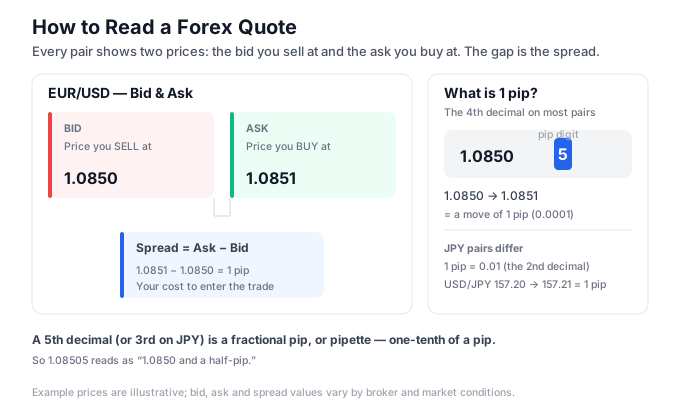
Brokers show two prices for every pair: the bid and the ask. The bid is the price you sell at; the ask is the price you buy at, always slightly higher than the bid.
The gap between them is the spread — your cost to enter. On EUR/USD that gap is often under 1 pip on a raw-spread account; on an exotic it can run 30 to 80 pips. Spread is the clearest reason to favour majors when you are starting out.
A pip is the standard unit of price movement. For most pairs 1 pip = 0.0001 (EUR/USD from 1.0850 to 1.0851 is 1 pip); for JPY pairs 1 pip = 0.01 (USD/JPY from 157.20 to 157.21). Our pips guide goes deeper on the math.
Most brokers now quote a fifth decimal (or a third on JPY pairs). That last digit is a fractional pip, or pipette, worth one-tenth of a pip — so 1.08505 reads as 1.0850 and a half-pip.
Why the base and quote order matters
The order is fixed by convention, and it changes how you read direction. USD is the base in USD/JPY, USD/CHF, and USD/CAD — a rising chart means the dollar is strengthening. USD is the quote in EUR/USD, GBP/USD, and AUD/USD — a rising chart means the dollar is weakening.
This matters the moment you trade more than one pair. Long EUR/USD and long USD/CHF is not diversification — you are short the dollar in one trade and long it in the other, cancelling yourself out.
Pip value also flows from the quote currency. When USD is the quote (EUR/USD, GBP/USD, AUD/USD), one standard lot is worth a clean $10 per pip, $1 per pip on a 0.10 lot (mini), and $0.10 per pip on a 0.01 lot (micro) — another reason USD-quoted majors are the easiest to size.
When USD is not the quote, pip value floats with the exchange rate and you have to convert. A currency converter handles that in a second so you are not sizing trades on a guess.
The three groups of currency pairs
Pairs are grouped by what they contain and how much they trade. These are not official regulatory categories — they are how the market talks about liquidity, spread, and risk. The labels tell you what to expect before you look at the chart.
Major pairs
The majors are the seven pairs that always include the US dollar against another large, freely-traded currency: EUR/USD, GBP/USD, USD/JPY, USD/CHF, USD/CAD, AUD/USD, NZD/USD.
They carry the deepest liquidity and tightest spreads in the market. EUR/USD alone is the most-traded pair on earth, which is why its spread is often the lowest your broker offers.
For most traders, the majors deserve the bulk of your screen time. Tight spreads mean a strategy needs a smaller edge to profit, and deep liquidity means your stop and entry fill close to where you expect.
Minor pairs (crosses)
Minor pairs, also called crosses, pair two major currencies without the US dollar. EUR/GBP, EUR/JPY, GBP/JPY, AUD/JPY, EUR/AUD, and GBP/CAD are common examples.
Crosses move on the relationship between two non-dollar economies, so they can trend cleanly when the majors are range-bound. GBP/JPY earned the nickname “The Beast” because its daily range routinely dwarfs EUR/USD.
The trade-off is wider spreads and bigger swings. A cross spread is typically 2 to 5 times a major’s, and the larger ranges force wider stops — which means smaller position sizes for the same dollar risk.
Exotic pairs
Exotic pairs put a major against an emerging-market currency: USD/ZAR (South African rand), USD/MXN (Mexican peso), USD/TRY (Turkish lira), USD/SGD, and similar.
Exotics carry thin liquidity, the widest spreads, and the sharpest, most sudden moves. A single central-bank surprise or political headline can move an exotic hundreds of pips in minutes.
For most retail accounts, exotics are not where you learn. The spread alone can swallow a scalp, and overnight swap charges on high-rate currencies are steep. Trade them only once you understand the country risk you are taking on.
How currency pair groups compare
Read this cheat sheet before you add a new pair — it tells you what you are signing up for in spread, range, and risk.
| Majors | Minors (crosses) | Exotics | |
|---|---|---|---|
| Contains USD | Always | No | Usually one side |
| Liquidity | Deepest | Moderate | Thin |
| Typical spread | Tightest | 2-5x a major | Widest (often 30-80 pips) |
| Volatility | Moderate | Higher | Highest and most sudden |
| Swap cost | Lowest | Moderate | Often high |
| Best for | Beginners, scalpers | Trend traders, swing | Experienced only |
The honest takeaway: spread and liquidity move together. The further you travel from the majors, the more the market charges you to enter and the more violently price can move against a tight stop. That does not make exotics untradeable — it makes them a deliberate choice.
What about gold (XAU/USD)
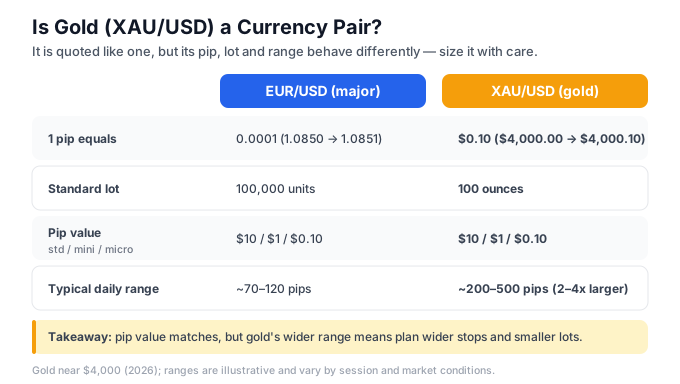
Gold is quoted as XAU/USD — XAU is the ISO code for gold, USD is the quote — so it reads like a currency pair. The price shows how many dollars buy one ounce; in 2026 that sits near $4,000.
But gold is not a normal pair, and treating it like one is a fast way to blow a stop. Its pip is different: 1 pip on gold is a $0.01 move (from $4,000.00 to $4,000.01), and a standard lot is 100 ounces. That works out to $1 per pip per standard lot, $0.10 per pip per 0.10 lot, $0.01 per pip per 0.01 lot.
Gold’s daily range also dwarfs the majors — routinely $20 to $50, roughly 2,000 to 5,000 pips at $0.01 per pip — with longer, faster wicks, especially around CPI, NFP, and FOMC. Plan for wider stops and smaller lots than on EUR/USD.
How to pick the right pair to trade
You do not need to trade every pair. Most consistent traders watch 3 to 6 and ignore the rest. Use these filters for your shortlist.
Start with a USD-quoted major. EUR/USD or GBP/USD give you tight spreads, clean $10-per-pip math, and the most educational content to learn from — the lowest-friction place to build a strategy if you are still learning how to start forex trading.
Match the pair to your session. AUD/USD, NZD/USD, and USD/JPY are most active in the Asian session (23:00-08:00 GMT); EUR/USD, GBP/USD, and EUR/GBP come alive in the London session (08:00-17:00 GMT). Trading a pair while its home market sleeps means thin moves and wide spreads.
Check the spread before the setup. A clean chart pattern on USD/TRY is worthless if the spread eats half your target. Check the spread first; if it is a large fraction of your stop, skip the pair.
Avoid stacking correlated pairs. Long EUR/USD and long GBP/USD is close to doubling one bet, because both rise when the dollar falls. A correlation matrix shows which pairs move together so you do not double your risk by accident.
Respect the volatility tier. A 20-pip stop that is sane on EUR/USD is far too tight on GBP/JPY or gold. Size the stop to the pair’s normal range, then size the position to your risk — never the other way around.
Common mistakes traders make with currency pairs
Thinking “buy EUR/USD” means buying euros only. Every pair trade is two-sided — long the base, short the quote. Fix: read every position as a relationship, “euro versus dollar,” not a single-currency bet.
Ignoring the quote currency when sizing. Pip value is clean only when USD is the quote; on EUR/GBP or GBP/JPY it floats. Fix: convert pip value to your account currency before you set lot size, or use a converter.
Trading exotics to “find opportunity.” New traders chase big moves on exotics and get destroyed by spread and swap. Fix: earn the right by being profitable on majors first.
Stacking correlated majors and calling it diversification. Long EUR/USD plus long AUD/USD plus short USD/CHF is one giant short-dollar bet. Fix: check correlation before adding a second position in the same direction.
Using one stop size across all pairs. A fixed 25-pip stop ignores that GBP/JPY moves two to three times as far as EUR/USD — and gold, measured in its own $0.01 pips, ranges many times wider still. Fix: set stops to each pair’s recent range, not a habit number.
Forgetting swap on overnight holds. Holding a high-interest exotic overnight can cost more in swap than the spread did. Fix: check the swap on both sides before holding past the daily rollover.
Currency pairs vs single instruments
Traders coming from stocks expect a pair to behave like a share. The difference is worth settling early.
| Currency pair | Single instrument (e.g. a stock) | |
|---|---|---|
| What you trade | One currency relative to another | One asset against your account currency |
| Direction | Relative — base vs quote | Absolute — the asset’s own price |
| “Going up” means | Base strengthening vs quote | The asset itself gaining value |
| Pip / tick value | Depends on the quote currency | Fixed per contract |
| Drivers | Two economies and their rate gap | One company or asset |
The relative nature of pairs is the key mental shift. A stock can rise on its own merits; a pair only rises because the base outperformed the quote. That is why one news event, like a US rate decision, moves every USD pair at once, in different directions depending on which side the dollar sits.
That relativity is why direction matters so much; if you are still nailing down entries, our going long or short guide maps buying and selling onto base and quote.
Frequently asked questions
What is the difference between the base and quote currency?
The base currency is the first in the pair and the one you buy or sell; the quote currency is the second, and the price is expressed in it. In EUR/USD, EUR is the base and USD is the quote. The price — 1.0850 — is how many dollars buy 1 euro.
What are major, minor, and exotic currency pairs?
Majors always include the US dollar against another large currency (EUR/USD, USD/JPY, and five others). Minors, or crosses, pair two majors with no USD, like EUR/GBP. Exotics pair a major with an emerging-market currency, like USD/ZAR. Spreads widen and liquidity thins as you move from majors to exotics.
What is the best currency pair for beginners?
EUR/USD is the standard starting pair. It has the tightest spreads, the deepest liquidity, clean $10-per-pip math on a standard lot, and more free educational material than any other pair. GBP/USD is a reasonable second. Both let you build a strategy without paying a wide spread on every trade.
Why is GBP/JPY so volatile?
GBP/JPY combines two currencies that can move sharply against the dollar, and against each other, so the swings compound. Its daily range often runs well beyond EUR/USD, which earned it the nickname “The Beast.” The bigger range means wider stops and smaller position sizes for the same risk.
How many currency pairs should I trade?
Most consistent traders watch 3 to 6 pairs, not the whole list. A focused watchlist lets you learn each pair’s range, spread, and session behaviour. Start with one or two USD-quoted majors, add a cross once you are profitable, and avoid stacking pairs that move together.
Is gold (XAU/USD) a currency pair?
Gold is quoted like a pair — XAU against USD — but it behaves differently. Its pip is a $0.01 move, a standard lot is 100 ounces, and its daily range of $20 to $50 (roughly 2,000 to 5,000 pips) dwarfs the majors. Treat it as its own instrument with wider stops and smaller lots, not as one more pair.
Glossary of related terms
- Base currency — the first currency in a pair; the one you buy or sell. In EUR/USD, EUR.
- Quote currency — the second currency in a pair; the price is expressed in it. In EUR/USD, USD.
- Major pair — a pair of USD against another large currency; tightest spreads, deepest liquidity.
- Minor / cross — a pair of two majors with no USD, like EUR/GBP.
- Exotic pair — a major against an emerging-market currency; thin and wide-spread.
- Pip — the standard unit of price movement; 0.0001 on most pairs, 0.01 on JPY pairs.
- Spread — the gap between bid and ask; your cost to enter a trade.
- Bid / ask — the price you sell at (bid) and buy at (ask).
Related reading
Risk disclaimer: Forex and CFD trading carries a high level of risk and may not be suitable for all traders. The strategies and indicators described in this article are educational. Past performance does not guarantee future results. Always test on a demo account before risking real capital.
Ready to put this into practice?
Open an account with a regulated broker and apply what you have learned. These are the three brokers we recommend:
Trading forex and CFDs carries a significant risk of loss and is not suitable for everyone. Broker links are affiliate links — we may earn a commission at no cost to you.