


Last updated: June 30, 2026 · By: Tim Morris, founder of ForexMT4Indicators.com
Swap in forex is the interest you pay or earn for holding a position past the daily rollover at 22:00 GMT. It comes from the interest-rate gap between the two currencies in your pair. The charge can be negative or positive, and it triples on Wednesday to cover the weekend.
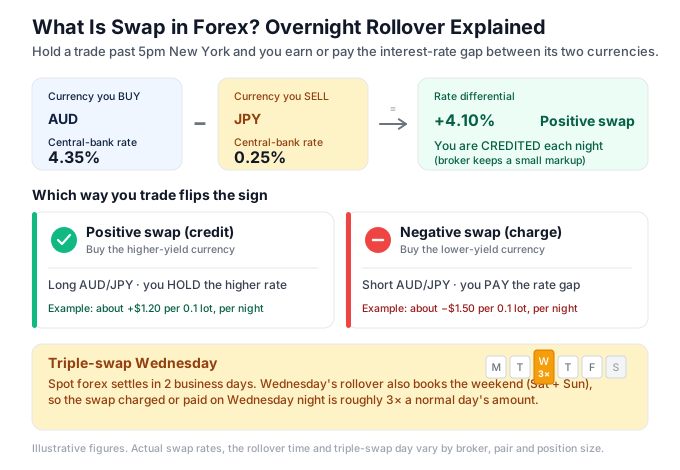
The diagram above shows how the rate differential between the two currencies turns into a positive or negative overnight swap, plus the triple charge on Wednesday. This guide explains where swap comes from, how to read it on your platform, and how it quietly adds up on gold and long-held trades. If you are new to the market, start with our forex trading primer, then come back here.
Table of contents
- What is swap in forex?
- What is rollover and when does it happen?
- Why swap exists: the interest-rate differential
- The components of a swap charge
- How to calculate the swap on a trade
- Triple swap Wednesday explained
- Swap on XAU/USD (gold)
- Common mistakes traders make with swap
- Swap vs spread vs commission
- Frequently asked questions
What is swap in forex?
Swap, also called rollover, is the interest adjustment applied to any forex position held open past the daily rollover time. Every currency carries an interest rate set by its central bank, and holding a pair means you are effectively long one currency and short the other.
The swap is the net of those two interest rates, applied to your position size. If the currency you are long pays a higher rate than the one you are short, you earn a small credit. If it pays a lower rate, you pay a charge. On most retail pairs and most directions, you pay.
The amount is usually small per night, often a few dollars on a 1.00 lot, but it compounds. Hold a negative-swap position for two weeks and the cost is real; hold it for two months and it can rival your spread cost many times over.
Swap only applies to positions held overnight. If you open and close a trade within the same trading day, before the 22:00 GMT rollover, you pay no swap at all. This is why intraday traders never think about it, while swing and position traders watch it closely.
What is rollover and when does it happen?
Rollover is the moment each day when open positions are “rolled” to the next settlement date, and it is the instant the swap is charged or credited. On most brokers it happens at 22:00 GMT (17:00 New York time), at the New York close.
The name comes from spot forex settlement convention. A spot trade technically settles two business days after the deal, and holding past rollover pushes that settlement date forward by one day. The swap is the cost of that extension, calculated from the rate differential.
You do not need to do anything for rollover to happen; it is automatic. If your position is open at 22:00 GMT, the swap hits your account; if it is closed by then, nothing happens. The 22:00 GMT time can shift by an hour around daylight-saving changes, so check your broker’s stated rollover time rather than assuming, especially in March and November.
Why swap exists: the interest-rate differential
Swap exists because currencies are not free to borrow. When you hold a forex pair, you are borrowing one currency to buy another, and the two carry different interest rates set by their central banks.
Picture a long EUR/USD position. You hold euros and owe dollars, so you earn the European Central Bank’s deposit rate on the euros and pay the Federal Reserve’s rate on the dollars. The swap is the difference between those two, scaled to your position size and adjusted by your broker’s markup.
When the rate you earn is higher than the rate you pay, the differential is positive and you receive a swap credit; when it is lower, you pay. Because brokers add a markup to both sides, the paid side is always larger than the equivalent earned side, so round-trip costs favour the broker.
This differential is the engine behind the carry trade, where traders deliberately hold positions to collect positive swap over months. For most short-term traders, though, swap is only a holding cost to manage, not a source of profit.
The components of a swap charge
Three inputs decide the size of any swap charge. Knowing them tells you why two positions of the same size can have wildly different overnight costs.
The interest-rate differential
The gap between the two currencies’ central-bank rates is the foundation. A pair like AUD/JPY, where one currency historically yields far more than the other, produces a large swap one way and a large charge the other. A pair where both rates sit close together produces a small swap either way.
Trade direction
Long and short on the same pair have opposite swaps. If long EUR/USD pays a charge, short EUR/USD usually earns a credit, minus the broker markup. This is why the swap-long and swap-short numbers your platform shows are almost never mirror images of each other.
Position size and broker markup
Swap scales with your lot size: a 1.00 lot is charged ten times the swap of a 0.10 lot. On top of the raw differential, your broker adds a markup, which is how brokers earn on overnight holds. Two brokers can quote the same pair with noticeably different swap because their markups differ, which is why picking the right broker is one of the early steps in how to start forex trading.
How to calculate the swap on a trade
You rarely need to compute swap by hand, because your platform and broker publish the per-lot figures. But understanding the formula lets you sanity-check the numbers and plan a multi-day hold.
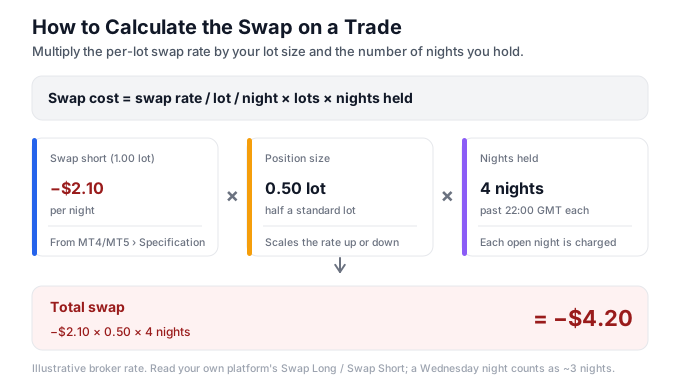
The formula is: swap cost = swap rate per lot per night x lots x nights held. To read the rate directly in MT4 or MT5, right-click the symbol in Market Watch, open Specification, and find the Swap Long and Swap Short values, which show the charge or credit per night for a 1.00 lot in each direction.
Worked example. Suppose your broker lists EUR/USD swap short at -$2.10 per 1.00 lot per night, and you hold a 0.50 lot short for 4 nights:
| Input | Value |
|---|---|
| Swap short (1.00 lot) | -$2.10 / night |
| Position size | 0.50 lot |
| Nights held | 4 |
| Total swap | -$2.10 x 0.50 x 4 = -$4.20 |
So the position costs $4.20 in swap over those 4 nights, on top of the spread you paid on entry, and more if one of those nights is a Wednesday. To skip the arithmetic on live broker rates, our swap calculator returns the overnight cost for any pair, direction, and lot size.
Triple swap Wednesday explained
On most brokers, the swap charged on Wednesday night is three times the normal amount. This is not a fee grab; it is settlement mechanics catching up with the calendar.
Spot forex settles two business days after the trade. A position held through Wednesday’s 22:00 GMT rollover settles on Friday, and that settlement then has to carry across the weekend when banks are closed. The broker books Saturday and Sunday’s interest in advance, so Wednesday’s swap covers three days instead of one.
The practical effect is straightforward. If a pair charges -$2 per night, expect roughly -$6 on Wednesday; if it pays +$2, expect about +$6 that night. The triple charge shifts to Friday on a minority of brokers, so confirm which night yours triples.
For carry traders chasing positive swap, triple Wednesday is the best night to be holding. For everyone holding a negative-swap position, it is the night the cost stings most, and a reason to think twice before carrying a losing trade into midweek.
Swap on XAU/USD (gold)
Gold deserves its own section because XAU/USD is the most-traded instrument among our readers in 2026, and its swap is one of the most overlooked costs of holding it overnight.
Gold has no central-bank interest rate of its own, so its swap is built differently from a currency pair. Brokers derive it from the cost of financing a gold position in US dollars, plus their markup. In practice both long and short gold positions usually carry a negative swap, so holding gold in either direction tends to cost you.
The numbers matter because of gold’s size. A standard XAU/USD lot is 100 ounces, where 1 pip is a $0.01 move, giving a pip value of $1 per pip per standard lot, $0.10 per 0.10 lot, and $0.01 per 0.01 lot. With gold near $4,000 in 2026, a single standard lot controls roughly $400,000 of metal, and the overnight financing on that notional is far from trivial.
That makes swap a real factor for gold swing trades. A negative gold swap held across a week, including a triple-charge night, can quietly remove a chunk of a winning trade. Before holding gold for days, check the swap-long and swap-short figures and budget them alongside the wider stops gold’s wicks already demand.
Common mistakes traders make with swap
Ignoring swap on multi-day holds. Traders budget for spread but forget the overnight cost stacks up every night. Fix: check the swap-long and swap-short values before any trade you plan to hold past 22:00 GMT, and multiply by your expected nights.
Forgetting triple-swap Wednesday. A position carried through Wednesday night is charged three days of interest at once. Fix: know which night your broker triples and factor a roughly 3x charge into midweek holds.
Assuming swap is symmetric. Many expect the credit for one direction to match the charge for the other. Fix: read both swap-long and swap-short separately; the broker markup makes the paid side larger than the earned side.
Chasing positive swap as free money. The carry trade collects positive swap, but exchange-rate moves can erase months of credits in a day. Fix: treat positive swap as a bonus on a sound trade, never as the reason to hold a position.
Applying forex logic to gold. Traders assume gold swap behaves like a currency pair and underestimate it. Fix: treat XAU/USD swap as a dollar-financing cost that is usually negative in both directions, and size gold holds accordingly.
Overlooking swap-free account terms. Swap-free (Islamic) accounts replace swap with an administration fee that can exceed the swap on long holds. Fix: compare the flat fee against the swap you would otherwise pay before assuming swap-free is cheaper.
Swap vs spread vs commission
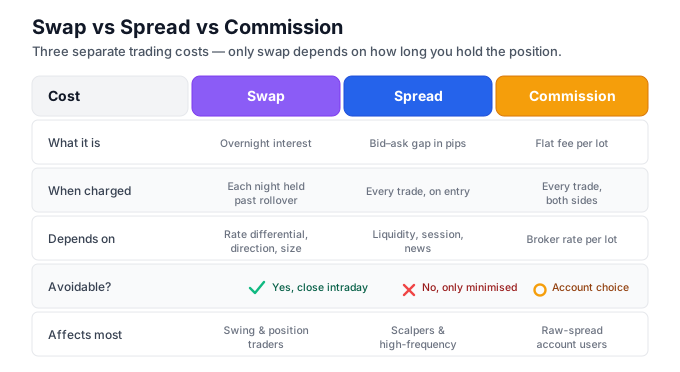
Swap, spread, and commission are three separate trading costs, and blurring them leads to mispriced trades. Settling the difference lets you judge a trade’s full cost.
| Swap | Spread | Commission | |
|---|---|---|---|
| What it is | Overnight interest | Bid-ask gap in pips | Flat fee per lot |
| When charged | Each night held past rollover | Every trade, on entry | Every trade, both sides |
| Depends on | Rate differential, direction, size | Liquidity, session, news | Broker rate per lot |
| Avoidable | Yes, by closing intraday | No, but can be minimised | Account choice |
| Who it affects most | Swing and position traders | Scalpers and high-frequency traders | Raw-spread account users |
The spread is unavoidable and hits every trade on entry; learn its mechanics in our guide to the spread. Commission applies mainly on raw-spread accounts, where it replaces most of the spread. Swap is the one cost you fully control: hold past 22:00 GMT and you pay or earn it; close before rollover and it never applies.
For a day trader, swap is irrelevant and spread is everything; for a position trader holding for weeks, swap can dwarf the spread. Matching your cost focus to your holding period is what separates traders who price their edge correctly from those who leak money on the wrong line item. Both costs scale with leverage, since a larger leveraged position carries a larger notional and therefore a larger swap.
Frequently asked questions
What is swap in forex trading?
Swap is the interest you pay or earn for holding a forex position overnight, past the daily rollover at 22:00 GMT. It comes from the interest-rate difference between the two currencies in your pair. If the currency you are long yields more than the one you are short, you earn a small credit; otherwise you pay a charge.
When is swap charged?
Swap is charged at the daily rollover, usually 22:00 GMT (17:00 New York time), at the close of the New York session. Only positions open at that moment are charged. If you open and close a trade within the same day, before rollover, you pay no swap. The exact time can shift by an hour around daylight-saving changes.
Why is swap tripled on Wednesday?
Because spot forex settles two business days after the trade, a position held through Wednesday’s rollover settles into the weekend when banks are closed. The broker books Saturday and Sunday’s interest in advance, so Wednesday’s swap covers three days instead of one. A pair charging -$2 per night typically charges about -$6 on Wednesday.
How do I calculate swap on a trade?
Use swap cost = swap rate per lot per night x lots x nights held. Find the per-lot rate in MT4 or MT5 by right-clicking the symbol in Market Watch and opening Specification to read Swap Long and Swap Short. A -$2.10 swap short on a 0.50 lot held 4 nights costs $2.10 x 0.50 x 4, which is $4.20.
Does gold (XAU/USD) have a swap?
Yes. Gold has no central-bank rate, so its swap is derived from the cost of financing a dollar-denominated gold position plus the broker’s markup. Both long and short gold positions usually carry a negative swap, so holding XAU/USD overnight in either direction tends to cost you. With gold near $4,000, a standard 100-ounce lot controls a large notional, making the charge meaningful.
How do I avoid paying swap?
Close your positions before the 22:00 GMT rollover and you pay no swap at all, which is what intraday traders do. For longer holds, a swap-free (Islamic) account removes the interest charge but usually adds a flat administration fee. Compare that fee against the swap you would otherwise pay before assuming swap-free is cheaper.
Related reading
Risk disclaimer: Forex and CFD trading carries a high level of risk and may not be suitable for all traders. The strategies and indicators described in this article are educational. Past performance does not guarantee future results. Always test on a demo account before risking real capital.
Ready to put this into practice?
Open an account with a regulated broker and apply what you have learned. These are the three brokers we recommend:
Trading forex and CFDs carries a significant risk of loss and is not suitable for everyone. Broker links are affiliate links — we may earn a commission at no cost to you.