


Last updated: June 30, 2026 · By: Tim Morris, founder of ForexMT4Indicators.com
Slippage in forex is the difference between the price you expected to trade at and the price your order actually filled at. It happens when the market moves in the split second between you clicking and the broker executing. Slippage can be negative (a worse fill) or positive (a better fill), and it grows during fast, thin, or news-driven markets.
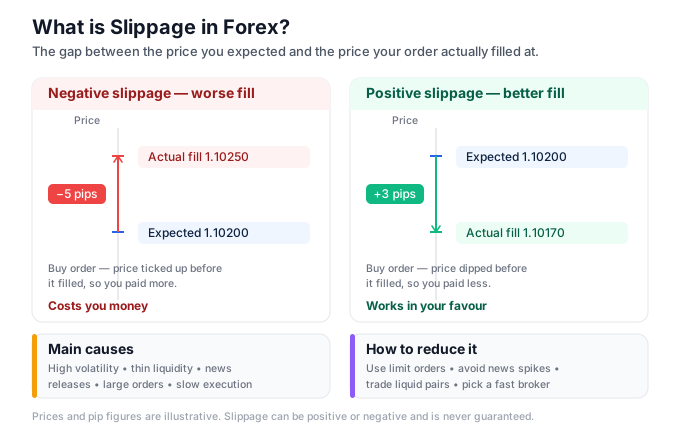
The diagram above shows the gap between an expected fill at 1.10200 and the actual fills on either side of it. This guide covers what causes slippage, how positive and negative slippage differ, the math on what it costs you, and the practical steps that keep it small. If you are still new to the mechanics of the market, start with our forex trading primer.
Table of contents
- What is slippage in forex?
- Why slippage happens
- Negative vs positive slippage
- What causes slippage
- How to calculate the cost of slippage
- Slippage on XAU/USD (gold)
- How to reduce slippage
- Common mistakes traders make with slippage
- Slippage vs spread vs requote
- Frequently asked questions
What is slippage in forex?
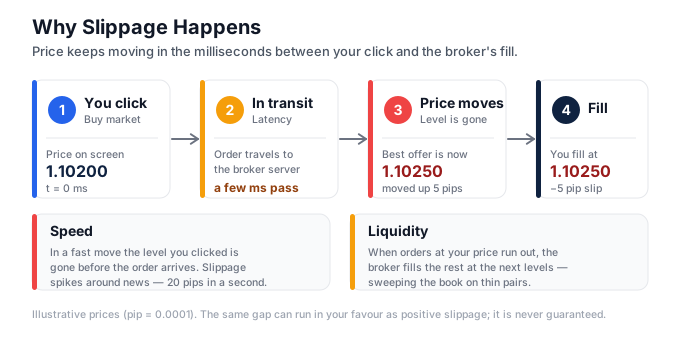
Slippage is the gap between your intended execution price and your real execution price. You ask to buy EUR/USD at 1.10200, but by the time the broker fills the order, the best available price has moved to 1.10250. That 5-pip difference is slippage.
It exists because forex is not a single fixed price. At any instant, price is a stack of bids and offers from many liquidity providers, and that stack shifts continuously. A market order takes whatever price is available when it reaches the server, not the price you saw on screen.
Slippage is normal and unavoidable on market orders. Every trader gets it, on every broker, in both directions. The goal is not to eliminate it but to keep it small and predictable, because uncontrolled slippage quietly widens your losses.
The term applies to entries, exits, stop losses, and take profits alike. A stop loss is a market order that triggers automatically, so it slips the same way a manual click does, which means slippage on a stop can push your real loss past the figure you planned.
Why slippage happens
Slippage comes down to one thing: price moved between the moment you committed and the moment the order executed. The two everyday triggers are speed and liquidity.
When price is moving fast, the level you clicked is gone before your order arrives at the broker’s server. The faster the move, the larger the gap. This is why slippage spikes around news releases, when price can travel 20 pips in under a second.
When liquidity is thin, there are not enough resting orders at your price to fill you, so the broker fills part of your order at the next available price, and the next, until the order is complete. On an illiquid pair or during a quiet session, even a normal-sized order can sweep through several price levels.
Execution speed plays a role too. A slow broker, a poor internet connection, or a distant server all add milliseconds, and in a fast market every millisecond is more room for price to drift.
Negative vs positive slippage
Slippage runs in both directions, and the names describe the effect on your wallet, not the direction of price.
Negative slippage is a worse fill than expected. You wanted to buy at 1.10200 but filled at 1.10250, so you paid 5 pips more. On a sell, negative slippage means you sold lower than intended. This is the type traders notice, because it costs money and shows up most often during volatility.
Positive slippage is a better fill than expected. You wanted to buy at 1.10200 but filled at 1.10170, so you paid 3 pips less. On a sell, positive slippage means you sold higher than intended. It works in your favour and happens when price ticks your way in the instant before execution.
A fair broker passes on both. If you only ever see negative slippage and never positive, that is a warning sign about execution quality, because genuine market execution produces slippage in both directions over a large sample of trades.
The asymmetry to watch is on stops. Negative slippage on a stop loss enlarges the loss, while positive slippage on a stop is rare because stops trigger into the move going against you. Plan your risk assuming stop slippage is more likely to hurt than help.
What causes slippage
Five conditions produce most of the slippage retail traders see. Knowing them tells you when to expect it and when to stand aside.
High-impact news releases
Releases like Non-Farm Payrolls (NFP), the Consumer Price Index (CPI), and Federal Open Market Committee (FOMC) decisions collapse liquidity for seconds while price gaps to a new level. Entering or holding through the exact release time is the single biggest source of large slippage.
Thin liquidity sessions
During the late Asian session and the daily rollover near 22:00 GMT, fewer participants are quoting, so orders walk through wider gaps. Exotic pairs like USD/ZAR and USD/TRY slip more than majors at all hours because their order books are thin.
Large order size
A position larger than the resting liquidity at the best price must fill across several levels. Retail micro and mini lots rarely hit this, but it becomes real on larger accounts and on illiquid instruments where even a standard lot moves the book.
Market gaps over the weekend
Forex closes Friday evening and reopens Sunday. If news breaks over the weekend, Monday’s open can gap well past your stop, filling it far from the intended level. Holding positions and stops over the weekend exposes you to this.
A fifth cause is slow execution. A laggy broker, a weak connection, or a high-latency server all add delay, and the more time between your click and the fill, the more price can drift. This is the cause you have the most direct control over through broker and platform choice.
How to calculate the cost of slippage
Slippage in pips means nothing until you convert it to money in your account currency. The math is the same as any pip-value calculation.
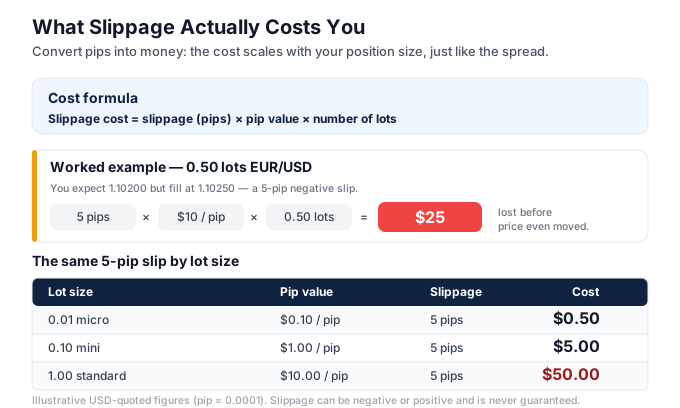
The cost formula is: slippage cost = slippage (in pips) x pip value x number of lots.
On a USD-quoted pair, pip value is about $10 per pip per 1.00 standard lot (100,000 units), $1 per pip per 0.10 mini lot, and $0.10 per pip per 0.01 micro lot. A pip is 0.0001 on most pairs and 0.01 on JPY pairs.
Worked example: you buy 0.50 lots of EUR/USD expecting 1.10200 but fill at 1.10250, a 5-pip negative slip. The cost is 5 x $10 x 0.50, which equals $25 you lost before price even moved.
| Slippage | Lot size | Pip value | Cost |
|---|---|---|---|
| 5 pips | 0.01 (micro) | $0.10 | $0.50 |
| 5 pips | 0.10 (mini) | $1.00 | $5.00 |
| 5 pips | 1.00 (standard) | $10.00 | $50.00 |
The same 5-pip slip costs a micro-lot trader 50 cents and a standard-lot trader $50. Slippage scales with position size exactly like the spread, so it matters far more on larger accounts and on instruments where slippage is routinely large, such as gold.
Slippage on XAU/USD (gold)
Gold deserves its own section because slippage on XAU/USD is bigger and more frequent than on the majors. Gold is the most-traded instrument among our readers in 2026, and its volatility makes slippage a real cost, not a rounding error.
A gold pip is a $0.01 price move, and a standard lot is 100 oz, so pip value is $1 per pip per 1.00 lot, $0.10 per pip per 0.10 lot, and $0.01 per pip per 0.01 lot. With gold trading near $4,000 in 2026, a fast move can slip your fill by $2 to $5 of price — 200 to 500 pips — in a single tick during the New York open.
Gold’s wider noise means stop slippage is the bigger danger. A stop on XAU/USD set during a calm hour can fill $3 or more past its level — 300-plus pips — when CPI or NFP hits, turning a planned 1% loss into a larger one. Size gold positions assuming stops can slip well beyond their set price, trade gold during the liquid London and New York sessions, and give stops room so a normal wick does not trigger them into a thin pocket.
How to reduce slippage
You cannot remove slippage, but you can keep it small. These steps are ordered by impact.
Use limit orders for entries where possible. A limit order fills only at your price or better, so it eliminates negative slippage on entry. The trade-off is that price may never reach your limit and you miss the trade. For mechanics, see our order types guide.
Avoid trading the exact moment of news. Spreads and slippage both blow out for seconds to minutes around NFP, CPI, and FOMC. Wait until liquidity returns before entering.
Trade liquid pairs and active sessions. Majors like EUR/USD during the London and New York overlap (13:00 to 17:00 GMT) carry the deepest liquidity and the smallest slips. Exotics and dead sessions slip more.
Pick a fast broker with quality execution. Low-latency servers and genuine market execution reduce the delay that lets price drift. Test fill quality on a small live account before committing size. If you are still working out where to begin as a new trader, our seven-step starter guide covers choosing a regulated broker and practising on demo first.
Avoid holding stops over the weekend. Weekend gaps can fill a stop far from its level, so close or reduce exposure into the Friday close if a position is sensitive to gap risk.
Size positions for the worst-case slip. Assume your stop can fill several pips past its level, especially on gold, and keep risk per trade at 1% or less so a slipped stop does not blow the plan.
Common mistakes traders make with slippage
Assuming the stop loss fills at its exact level. A stop is a market order and slips like any other. Fix: plan risk assuming the stop fills a few pips worse, and never set risk so tight that a normal slip ruins the trade.
Trading the news spike with market orders. Entering at the release fills you deep into a fast move at a terrible price. Fix: wait for liquidity to return, or use a limit order at a level you actually want.
Blaming the broker for all slippage. Some slippage is the market, not the broker. Fix: check whether you also get positive slippage; if fills only ever go against you, then question execution quality.
Scalping tight targets on illiquid pairs. A 5-pip target on an exotic that slips 3 pips per fill has no edge left. Fix: scalp only deep-liquidity majors, and keep targets well above typical slippage plus the spread.
Ignoring weekend gap risk. Leaving a stop over the weekend can fill it far past its level on Monday’s open. Fix: reduce or close gap-sensitive positions into the Friday close.
Applying forex slippage expectations to gold. Gold slips far more than EUR/USD, and traders underestimate it. Fix: treat XAU/USD as a distinct instrument and budget for 20 to 50 pip slips during fast windows.
Slippage vs spread vs requote
Slippage, the spread, and a requote are three separate execution costs, and traders often confuse them. Settling the difference helps you read your fills correctly.
| Slippage | Spread | Requote | |
|---|---|---|---|
| What it is | Price moved before the fill | Bid-ask gap on every trade | Broker rejects, offers a new price |
| Direction | Negative or positive | Always a cost | Neither; you accept or decline |
| When it appears | Fast or thin markets | Every market order | Fixed-spread or dealing-desk accounts |
| You control it via | Order type, timing, broker | Pair and session choice | Choosing a market-execution broker |
| Avoidable | Reduced, not removed | No, only minimised | Yes, on true market execution |
The spread is the bid-ask gap you pay on entry no matter what, while slippage is the extra movement on top of that gap during execution. Both stack into your real cost, so a fast trade in volatile conditions can cost the spread plus several pips of slippage on the same fill.
A requote is different again: instead of slipping, the broker refuses your price and offers a new one to confirm. Requotes are a dealing-desk and fixed-spread phenomenon. True market-execution accounts do not requote; they fill you with slippage instead, which is usually the better deal for an active trader.
To compare what brokers charge before you commit, our compare broker spreads tool puts typical costs side by side, a useful proxy for overall execution quality.
Frequently asked questions
What is slippage in forex trading?
Slippage is the difference between the price you expected and the price your order actually filled at. It happens because the market moves in the moment between your click and the broker’s execution. Slippage can be negative (a worse price) or positive (a better price), and it grows during fast, thin, or news-driven markets.
Is slippage always bad?
No. Slippage can be positive, meaning you get a better fill than expected, or negative, meaning a worse fill. A fair broker passes on both directions over time. Negative slippage costs you money and shows up most during volatility; positive slippage works in your favour when price ticks your way in the instant before the fill.
How do I avoid slippage on my stop loss?
You cannot fully avoid it, because a stop loss is a market order that slips like any other. Reduce it by trading liquid pairs, avoiding the exact moment of high-impact news, and not holding stops over the weekend. Always plan risk assuming the stop fills a few pips past its level, especially on gold.
Why is slippage worse on gold (XAU/USD)?
Gold is more volatile than the majors and its liquidity thins fast during news, so price can jump $2 to $5 in a single tick — 200 to 500 pips. With XAU/USD near $4,000 in 2026, those moves are large in money terms. Stops on gold can fill $3 or more past their level (300-plus pips) around CPI, NFP, and FOMC.
What is the difference between slippage and spread?
The spread is the fixed bid-ask gap you pay on every trade. Slippage is the extra price movement between your click and the fill, on top of the spread. The spread is always a cost; slippage can go either way. Both stack into your real execution cost.
Can I get slippage with a limit order?
Not in the negative direction. A limit order fills only at your chosen price or better, so it removes negative slippage on entry. The trade-off is that price may never reach your limit and you miss the trade. Market orders fill immediately but accept slippage; limit orders control price but not the fill.
Related reading
Risk disclaimer: Forex and CFD trading carries a high level of risk and may not be suitable for all traders. The strategies and indicators described in this article are educational. Past performance does not guarantee future results. Always test on a demo account before risking real capital.
Ready to put this into practice?
Open an account with a regulated broker and apply what you have learned. These are the three brokers we recommend:
Trading forex and CFDs carries a significant risk of loss and is not suitable for everyone. Broker links are affiliate links — we may earn a commission at no cost to you.