


Last updated: June 30, 2026 · By: Tim Morris, founder of ForexMT4Indicators.com
Margin in forex is the deposit your broker locks to let you hold a leveraged position. It is not a fee or a loss — it is collateral, equal to the position’s notional value divided by your leverage. Your account then tracks equity, used margin, free margin, and a margin level percentage that triggers margin calls and stop-outs.
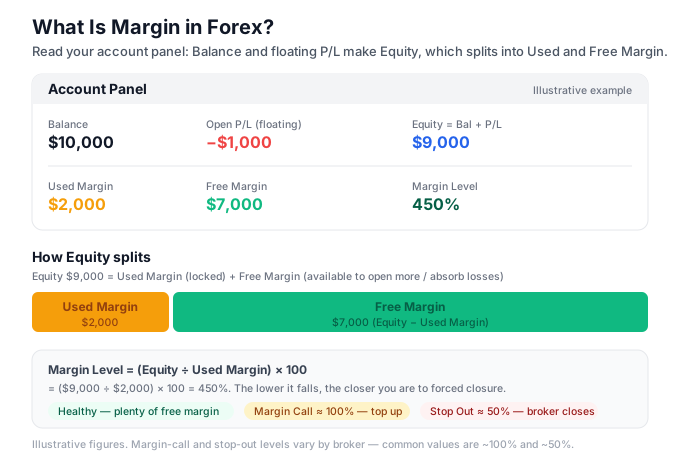
The diagram above is the account panel you will stare at every trading day, and reading it correctly is the difference between a controlled trade and a forced liquidation. Below we define each term, work the exact math, and show where the margin call and stop-out thresholds sit. Margin is the flip side of leverage, so if you have not read that yet, the two pages work together.
Table of contents
- What is margin in forex?
- Why margin matters
- The components: balance, equity, used and free margin
- How to calculate margin and margin level
- What is a margin call and a stop-out?
- Margin on XAU/USD (gold)
- Common margin mistakes
- Margin vs free margin vs margin level
- Frequently asked questions
What is margin in forex?
Margin is the slice of your own money the broker sets aside as security when you open a leveraged trade. The broker funds the rest of the position; the margin is your good-faith deposit that the trade can move against you a little before anyone steps in.
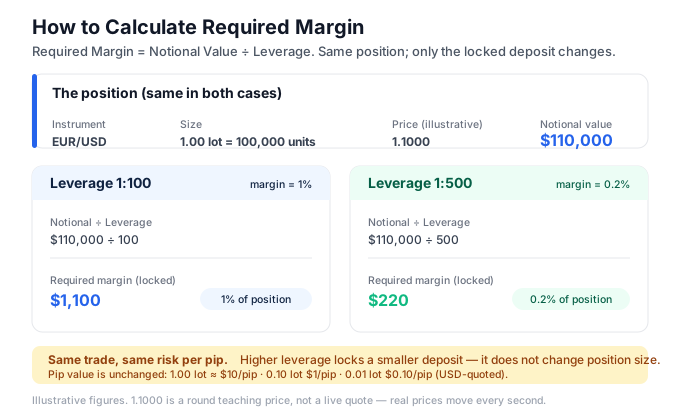
The amount is fixed by a formula, not by guesswork: required margin equals the position’s notional value divided by the leverage ratio. At 1:100 leverage, margin is 1% of the position; at 1:500, it is 0.2%. A position is the same size and carries the same risk per pip whichever leverage you use — only the locked deposit changes.
The word “margin” then gets reused for a whole family of account readings: used margin, free margin, margin level, margin call, and stop-out. Beginners blur these together and panic at the wrong moment. Keeping them distinct is the single most useful thing on this page. If you are still setting up, our 7-step beginner’s walkthrough covers the groundwork every new trader needs, from choosing a regulated broker to sizing a first trade at 1%.
Margin is collateral that is returned to your free balance the instant you close the position. It is not spent and it is not a cost of the trade — your real costs are the spread and any swap. Margin is only parked while the trade is open.
Why margin matters
Margin is what decides how many positions you can hold at once and how much room you have before the broker closes them for you. Ignore it and you can be force-liquidated at the worst possible price, even on a trade that would have recovered minutes later.
Every position you open shrinks your free margin. Run that number too low and a normal pullback can trip the margin call and then the stop-out, wiping good trades along with bad ones. The traders who survive watch free margin the way they watch their stop loss.
Margin also exposes over-leveraging before it becomes fatal. If opening one more lot would drop your margin level near the broker’s stop-out threshold, the account is telling you, in plain numbers, that you are carrying too much size.
The components: balance, equity, used and free margin
The account panel has five readings that move together. Get these straight and the rest of the page is arithmetic.
Balance and equity
Balance is your closed-trade money — the cash in the account when no positions are open. It only changes when a trade closes, a deposit lands, or a withdrawal clears.
Equity is your balance plus or minus the floating profit and loss of every open position. Equity is the live, real-time value of the account. In the diagram, a $10,000 balance with a $1,000 floating loss gives $9,000 of equity.
Equity is the number that actually matters, because every margin calculation runs off equity, not balance. When trades are closed, balance and equity are equal; once a position is open, they diverge by the floating P/L.
Used margin and free margin
Used margin is the total deposit locked across all your open positions — the sum of each position’s required margin. In the diagram, $2,000 is held as used margin.
Free margin is equity minus used margin: the money still available to open new trades and, more importantly, to absorb losses on the trades you already hold. The diagram shows $7,000 of free margin ($9,000 equity − $2,000 used margin).
Free margin is your survival buffer. As floating losses grow, equity falls, and free margin falls with it. When free margin reaches zero, you cannot open new trades and you are one step from a margin call.
How to calculate margin and margin level
Two formulas cover almost everything. Both are arithmetic, and both are worth committing to memory.
Required margin = Notional value ÷ Leverage. For 1 standard lot of EUR/USD (100,000 units) at an illustrative price of 1.1000, notional value is $110,000. At 1:100 leverage the margin is $110,000 ÷ 100 = $1,100; at 1:500 it is $220. Treat 1.1000 as a round teaching number, not a live quote — real prices move every second.
The pip value sits alongside the margin and drives your actual profit and loss. One standard lot on a USD-quoted pair is about $10 per pip; a 0.10 mini lot is $1 per pip; a 0.01 micro lot is $0.10 per pip. Margin decides how much is locked; pip value decides how fast equity changes. For a quick check on any trade, our margin calculator does the division for you.
Margin level = (Equity ÷ Used margin) × 100. This percentage is the health gauge. Using the diagram’s numbers, ($9,000 ÷ $2,000) × 100 = 450%. The higher the number, the more cushion you have; the lower it falls, the closer you are to a forced close.
A margin level of 450% is comfortable. As floating losses pull equity down toward the used margin figure, the percentage slides toward 100%, where most brokers fire the margin call. Watch this number, not only your balance, because balance does not move while trades float.
If you would rather size a trade to a fixed dollar risk and let the margin fall out of it, work backward from your stop with our lot size calculator. Sizing to risk first keeps your margin level healthy as a by-product.
What is a margin call and a stop-out?
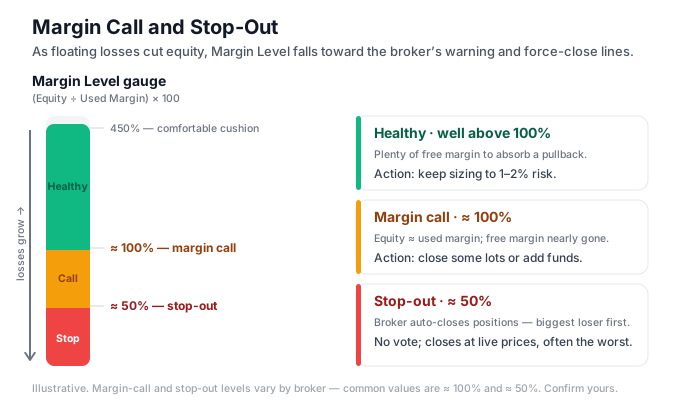
A margin call is the broker’s warning that your margin level has dropped to a danger threshold — commonly around 100%, meaning equity has fallen to roughly the used margin figure. At that point you have almost no free margin left to absorb further losses.
When a margin call hits, you have two real choices: close some positions to release used margin, or add funds to lift equity. Both raise the margin level back into safe territory. Hoping the trade turns around is not a plan; it is how accounts get liquidated.
The stop-out is the harder line, commonly near 50%. When your margin level reaches the stop-out level, the broker automatically closes your positions — usually the largest loser first — until the margin level climbs back above the threshold. You do not get a vote, and the closes happen at live market prices, often the worst available.
These exact percentages vary by broker, which is why the diagram labels them as approximate. Common retail values are a margin call near 100% and a stop-out near 50%, but confirm your own broker’s figures before you size positions.
The practical takeaway: a margin call is not a penalty, it is a fuel light. Stop-out is running out of fuel on the motorway. You avoid both by keeping free margin high — which means sizing positions to risk, not to the maximum the account will allow.
Margin on XAU/USD (gold)
Gold (XAU/USD) is the most-traded retail instrument in 2026, and margin behaves the same way mechanically — but gold’s bigger swings eat free margin much faster.
Gold’s pip value is $1 per pip per standard lot, $0.10 per pip per 0.10 lot, and $0.01 per pip per 0.01 lot. The required margin still equals notional value divided by leverage. With gold near $4,000 in 2026, a 1.00 lot (100 oz) carries a notional value of about $400,000, so at 1:100 the margin is roughly $4,000.
The difference is the daily range. Gold routinely moves $20 to $50 a day (about 2,000 to 5,000 pips), several times a major pair’s typical move. A 0.10 lot gold position can therefore swing $200 to $500 in floating P/L in a single session, dragging equity — and your margin level — far harder than the same lot size on EUR/USD.
The fix is smaller lots and wider stops. When you move a strategy from a forex pair to gold, cut the lot size by roughly half to two-thirds so one of gold’s routine wicks does not collapse your free margin into a stop-out. The margin formula has not changed; gold’s volatility has made free margin more precious.
Common margin mistakes
Watching balance instead of margin level. Balance does not move while trades are open, so it tells you nothing about danger. Fix: keep your eyes on equity and the margin level percentage, which update tick by tick.
Treating margin as a cost. Margin is collateral that returns to free margin the moment you close — it is not spent. Fix: budget for the spread and swap as your real costs, and treat margin as parked, not gone.
Sizing to maximum available margin. A $1,000 account at 1:500 can lock the margin for huge notional value, but that leaves almost no free margin to absorb a normal pullback. Fix: size every trade to a fixed 1% to 2% account risk and ignore the maximum.
Ignoring floating losses on other positions. Used margin is fixed per position, but free margin falls as any open trade moves against you. Fix: total the floating P/L across all positions, not only the trade you are watching.
Forgetting the stop-out closes the biggest loser first. Traders assume a margin call gives them time; the stop-out can liquidate mid-move with no warning. Fix: never let your margin level drift toward the stop-out threshold — act at the margin call, or earlier.
Assuming every broker uses the same thresholds. Margin call near 100% and stop-out near 50% are common, not universal. Fix: confirm your broker’s exact margin call and stop-out percentages before you trade size.
Margin vs free margin vs margin level
These three readings get mixed up constantly, and the confusion is what triggers avoidable liquidations. The table separates them.
| Used margin | Free margin | Margin level | |
|---|---|---|---|
| What it is | Deposit locked on open positions | Equity not locked, available to trade or absorb losses | Equity ÷ used margin, as a percentage |
| Formula | Notional value ÷ leverage | Equity − used margin | (Equity ÷ used margin) × 100 |
| Moves when | You open or close a position | Any open trade’s floating P/L changes | Equity or used margin changes |
| Healthy reading | As small a share of equity as sensible | High — a thick buffer | Well above 100% (the diagram shows 450%) |
| Danger sign | Large relative to equity | Near zero | Approaching 100% (call) or 50% (stop-out) |
Think of it as one chain: used margin is locked, free margin is what is left, and margin level is the ratio that tells the broker whether to act. You manage all three by controlling one thing — position size.
Equity sits underneath all of them. Because every reading runs off equity rather than balance, a string of floating losses can push you toward a margin call even while your closed-trade balance looks untouched. That gap between balance and equity is exactly where over-leveraged accounts get caught.
Frequently asked questions
What is a margin call and how do I avoid it?
A margin call is a broker warning that your margin level has fallen to a danger threshold, often around 100%, meaning equity has dropped close to your used margin. Avoid it by sizing trades to 1% to 2% risk, always using a stop loss, and keeping plenty of free margin so a normal pullback cannot push the margin level down to the warning line.
What’s the difference between balance and equity?
Balance is your closed-trade cash — it only changes when a position closes or you deposit or withdraw. Equity is balance plus or minus the floating profit and loss of all open trades, so it updates every tick. When no trades are open, balance and equity are equal. Every margin calculation runs off equity, not balance, which is why equity is the number that matters live.
How do I calculate margin level?
Margin level = (Equity ÷ Used margin) × 100. If equity is $9,000 and used margin is $2,000, the margin level is 450%. A higher percentage means more cushion; as floating losses pull equity down toward the used margin figure, the percentage falls toward 100% (margin call) and then 50% (stop-out). Brokers use the margin level, not your balance, to decide when to act.
What is free margin in forex?
Free margin is equity minus used margin — the money still available to open new positions and to absorb losses on trades you already hold. If equity is $9,000 and used margin is $2,000, free margin is $7,000. It is your survival buffer: as open trades move against you, equity falls and free margin shrinks. When it hits zero, you cannot open trades and a margin call is close.
What happens at the stop-out level?
At the stop-out level — commonly around 50% margin level — the broker automatically closes your positions, usually the largest loser first, until the margin level rises back above the threshold. You have no say, and closes happen at live prices that are often the worst available. The stop-out exists to stop your account going negative; you avoid it by keeping free margin high and never over-positioning.
Does margin work the same on gold (XAU/USD)?
Mechanically yes — required margin still equals notional value divided by leverage, and gold’s pip value is $1 per pip per standard lot. The difference is gold’s $20 to $50 daily range (about 2,000 to 5,000 pips), which moves equity and your margin level far faster than a forex pair. Use smaller lots and wider stops on gold so a routine wick does not drain free margin into a stop-out.
Is margin a fee or a loss?
Neither. Margin is collateral the broker locks while a position is open and returns to your free margin the moment you close it — it is not deducted as a cost and it is not a loss. Your real trading costs are the spread and any overnight swap. Thinking of margin as “spent” leads traders to misjudge how much free margin they actually have.
Glossary of related terms
- Margin — the deposit locked to hold a leveraged position; equals notional value divided by leverage.
- Balance — your closed-trade cash; changes only when a position closes or you deposit or withdraw.
- Equity — balance plus or minus floating P/L on open trades; the live value of the account.
- Used margin — the total deposit locked across all open positions.
- Free margin — equity minus used margin; available to open trades or absorb losses.
- Margin level — equity divided by used margin, shown as a percentage; the broker’s health gauge.
- Margin call — a broker warning (often near 100% margin level) that free margin is running low.
- Stop-out level — the margin level (often near 50%) at which the broker force-closes positions.
- Leverage — a ratio (1:100, 1:500) showing how much position size each dollar of margin controls. See leverage in forex.
- Pip value — the cash value of a one-pip move; about $10 per pip per standard lot on a USD-quoted pair. See what is a pip.
Related reading
Risk disclaimer: Forex and CFD trading carries a high level of risk and may not be suitable for all traders. The strategies and indicators described in this article are educational. Past performance does not guarantee future results. Always test on a demo account before risking real capital.
Ready to put this into practice?
Open an account with a regulated broker and apply what you have learned. These are the three brokers we recommend:
Trading forex and CFDs carries a significant risk of loss and is not suitable for everyone. Broker links are affiliate links — we may earn a commission at no cost to you.