


Last updated: June 30, 2026 · By: Tim Morris, founder of ForexMT4Indicators.com
The spread in forex is the difference between the bid price (the price at which you sell) and the ask price (the price at which you buy) on the same pair at the same instant, measured in pips. It is the broker’s built-in fee on every trade. On EUR/USD a typical spread is 0.5 to 1.5 pips: a 1-pip spread costs $10 on a standard lot, so a typical 0.5-1.5 pip spread runs about $5-$15 on entry.
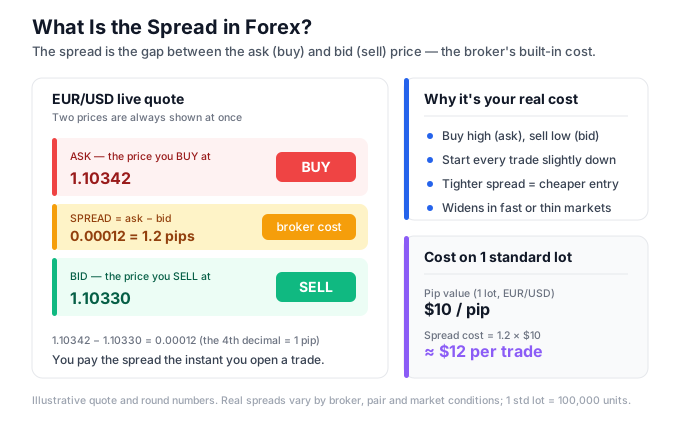
The diagram above shows the bid-ask gap and why you start every trade slightly in the red. This guide breaks down where the spread comes from, how to calculate its real cost in your account currency, and how it quietly erodes scalping and gold strategies. If you are new to the wider market, start with our forex trading primer, then come back here.
Table of contents
- What is the spread in forex?
- Bid, ask and the spread explained
- Why the spread matters for your account
- The components of forex spread cost
- How to calculate the true cost of the spread
- Fixed vs variable spreads
- Spread on XAU/USD (gold)
- Common mistakes traders make with spreads
- Spread vs commission vs swap
- Frequently asked questions
What is the spread in forex?
The spread is the gap between two prices your broker quotes for the same currency pair at the same instant. The lower price is the bid (the price at which you sell); the higher price is the ask (the price at which you buy). Both are quoted simultaneously on the same pair. You always buy at the ask and sell at the bid, so the spread is the cost you pay for crossing that gap.
Brokers earn the spread on every position you open. It is not a separate line item like a commission; it is baked into the prices themselves, which is why many beginners trade for months without noticing they pay it on every trade.
The spread is quoted in pips. A pip is the smallest standard price move on a pair: 1 pip equals 0.0001 on most pairs, and 0.01 on JPY pairs. If EUR/USD shows a bid of 1.08500 and an ask of 1.08515, the spread is 1.5 pips. For a refresher on the unit, read our explainer on what is a pip.
The size of the spread depends on the pair’s liquidity, the time of day, and your broker’s pricing model. Majors like EUR/USD carry the tightest spreads because they trade in enormous volume. Exotics like USD/ZAR carry much wider spreads because fewer participants quote them.
Bid, ask and the spread explained
Three numbers define every forex quote: the bid, the ask, and the spread between them. Understanding which side you transact on is the whole game.
Bid price is the price at which you can sell the base currency to your broker. It is always the lower of the two quoted prices. When you click “sell,” you get filled at the bid.
Ask price (sometimes called the offer) is the price at which you can buy the base currency from your broker. It is always the higher of the two prices. When you click “buy,” you get filled at the ask.
Spread is ask minus bid. With a EUR/USD bid of 1.08500 and an ask of 1.08512, the spread is 0.00012, which equals 1.2 pips. That gap is your immediate, unavoidable entry cost.
This is why a fresh trade shows a small floating loss the instant it opens. You bought at the ask, but the platform marks your position against the bid, so price has to move in your favour by at least the spread before you break even.
Why the spread matters for your account
The spread is a fixed tax on activity, and it scales with how often you trade. A swing trader who takes 5 trades a month barely feels a 1-pip spread. A scalper taking 20 trades a day pays that same pip 400 times a month, and it compounds into real money.
Tight stops magnify the problem. If your strategy risks a 5-pip stop on EUR/USD and the spread is 1.5 pips, the spread is already 30% of your risk before price moves. The same spread against a 50-pip swing stop is 3% of risk, far easier to absorb.
The spread also defines your true break-even point. A trade is not profitable when price returns to your entry; it is profitable only after price clears the spread plus any commission. On wide-spread instruments this distinction separates traders who budget for costs from those who slowly bleed.
The components of forex spread cost
The headline spread is one number, but three forces decide how big it gets. Knowing them helps you trade when costs are lowest.
Liquidity
Liquidity is how many buyers and sellers are quoting a pair at once. High liquidity tightens the spread because competing market makers narrow the gap. EUR/USD, the most-traded pair, routinely shows spreads under 1 pip. Thinly traded exotics widen to 20, 50, or 100 pips.
Session and time of day
Spreads breathe with the trading sessions. During the London and New York overlap (13:00 to 17:00 GMT) liquidity peaks and spreads tighten. During the late Asian session and the daily rollover near 22:00 GMT, liquidity thins and spreads widen, sometimes by 3 to 5 times. These GMT times shift by an hour when London or New York observes daylight saving time, so confirm the overlap against your own clock during the spring and autumn changeovers.
Volatility and news
High-impact news collapses liquidity for a few seconds to a few minutes. Around NFP (08:30 ET) or a Fed decision, spreads that sat at 1 pip can blow out to 10 or 20 pips. Trading the exact moment of a release is a known way to overpay on cost and slippage.
How to calculate the true cost of the spread
The spread in pips is meaningless until you convert it to money in your account currency. The formula is short and you should run it before any high-frequency strategy.
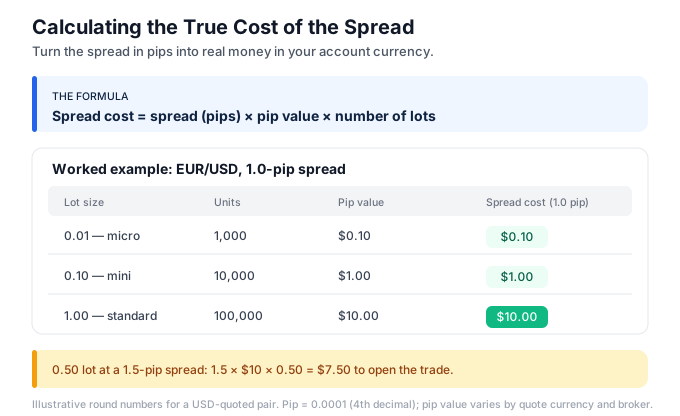
The cost formula is: spread cost = spread (in pips) x pip value x number of lots.
First, find the pip value for your lot size. A lot is the standardised trade size your position is measured in. On a USD-quoted pair, 1 pip is worth about $10 per 1.00 standard lot (100,000 units), $1 per 0.10 mini lot, and $0.10 per 0.01 micro lot.
Worked example on EUR/USD with a 1.0-pip spread:
| Lot size | Units | Pip value | Spread cost (1.0 pip) |
|---|---|---|---|
| 0.01 (micro) | 1,000 | $0.10 | $0.10 |
| 0.10 (mini) | 10,000 | $1.00 | $1.00 |
| 1.00 (standard) | 100,000 | $10.00 | $10.00 |
So a 1.0-pip spread on a 1.00 lot costs $10 to open. Trade a 0.50 lot at a 1.5-pip spread and the cost is 1.5 x $10 x 0.50, which equals $7.50. Scale that across 200 monthly trades and the spread alone runs into hundreds of dollars.
To compare what different brokers charge before you commit, our compare broker spreads tool puts live and typical spreads side by side.
Fixed vs variable spreads
Brokers offer two pricing models, and the right one depends on how and when you trade.
Fixed spreads stay constant regardless of market conditions. A broker might guarantee 2 pips on EUR/USD around the clock. This helps planning, but the fixed number is usually wider than a variable spread during calm hours, and fixed-spread brokers may requote during fast markets.
Variable spreads float with live liquidity. They can drop below 0.2 pips on EUR/USD during the London/New York overlap and widen sharply during news. ECN (electronic communication network) and raw-spread accounts, which route your order to liquidity providers directly, use this model, often pairing a near-zero spread with a fixed commission.
For most active traders on majors, a variable raw-spread account with commission works out cheaper than a fixed-spread account, provided you avoid trading through high-impact news.
Spread on XAU/USD (gold)
Gold deserves its own section because its spread behaves nothing like a major pair. XAU/USD is the most-traded instrument among our readers in 2026, and its spread is one of the biggest hidden costs they overlook.
On retail brokers the typical XAU/USD spread runs 15 to 35 pips, where a gold pip is a $0.01 move (the last decimal of the quote). Tighter brokers offer 10 to 20 pips. That is far wider than EUR/USD, so gold scalping with tight targets is brutal on cost.
Gold pip value follows its own structure: a standard lot of gold is 100 ounces, so 1 pip is worth $1.00 per 1.00 lot, $0.10 per 0.10 lot, and $0.01 per 0.01 lot. A 20-pip gold spread on a standard lot therefore costs 20 x $1.00, which equals $20 to open the position (the same 20 pips is $0.20 of price, since each pip is a $0.01 move). If your target is 30 pips, two-thirds of the move is eaten before you profit.
Gold’s spread also widens hard during the New York open and around CPI, NFP, and FOMC, when XAU/USD is most volatile. Sizing for gold means budgeting for both the wider spread and the wider stops gold’s wicks demand. If you hold gold overnight, the swap calculator shows the rollover cost that stacks on top of the spread.
Common mistakes traders make with spreads
Ignoring the spread when setting tight stops. A 5-pip stop with a 1.5-pip spread risks 30% of your stop to cost alone. Fix: size stops so the spread is under 10% of your stop distance, or trade higher timeframes.
Scalping during low-liquidity hours. Late Asian session and the 22:00 GMT rollover carry the widest spreads of the day. Fix: scalp majors during the London/New York overlap (13:00 to 17:00 GMT) when spreads are tightest.
Trading the moment of a news release. Spreads blow out to 10 to 20 pips around NFP and FOMC, and fills slip badly. Fix: wait until liquidity returns, usually a few minutes after the release, before entering.
Confusing the spread with the full cost. On raw-spread accounts the near-zero spread hides a separate commission. Fix: add commission to the spread for the true round-trip cost before judging a broker as cheap.
Applying forex pip math to gold. Many traders assume XAU/USD spreads behave like EUR/USD and underestimate the cost. Fix: treat gold as a distinct instrument with a 15 to 35 pip spread and size positions accordingly.
Never comparing brokers. Traders stay on a 2-pip account when 0.3-pip plus commission accounts exist. Fix: compare typical spreads on the pairs you actually trade, not only EUR/USD headline numbers.
Spread vs commission vs swap
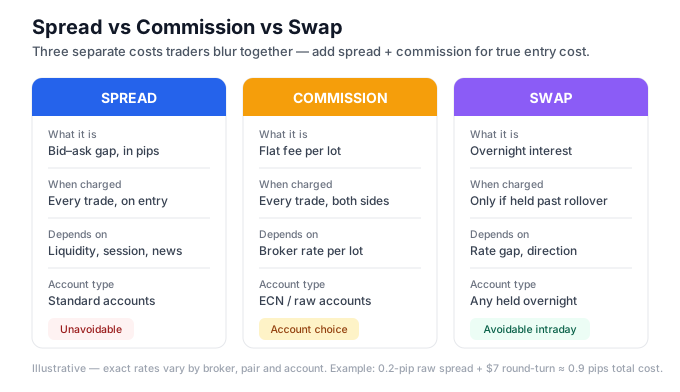
Spread, commission, and swap are three separate costs, and traders often blur them. Settling the difference is what lets you compare account types honestly.
| Spread | Commission | Swap | |
|---|---|---|---|
| What it is | Bid-ask gap in pips | Flat fee per lot | Overnight interest |
| When charged | Every trade, on entry | Every trade, both sides | Only if held past rollover |
| Depends on | Liquidity, session, news | Broker rate per lot | Rate differential, direction |
| Account type | Standard accounts | ECN/raw accounts | All accounts holding overnight |
| Avoidable | No, but can be minimised | Account choice | Yes, by closing intraday |
The spread is unavoidable on every trade, though you reduce it by choosing liquid pairs and active sessions. Commission applies on raw-spread accounts, where it replaces most of the spread. Swap applies only when you hold a position past the daily rollover, so intraday traders avoid it entirely.
For a fair broker comparison, add the spread and commission together. A 0.2-pip raw spread with a $7 round-turn commission per standard lot equals roughly 0.9 pips of total cost, which beats a 2-pip fixed account on majors.
Frequently asked questions
What is the spread in forex trading?
The spread is the difference between the bid price (where you sell) and the ask price (where you buy) on a currency pair, measured in pips. It is the broker’s built-in cost on every trade. On EUR/USD the spread is often 0.5 to 1.5 pips, meaning price must move that far in your favour before the trade breaks even.
How do I calculate the cost of the spread?
Use spread cost = spread (in pips) x pip value x lots. On a USD-quoted pair, pip value is about $10 per standard lot, $1 per mini lot, $0.10 per micro lot. A 1.5-pip spread on a 0.10 lot costs 1.5 x $1 x 1, which is $1.50 to open the position. Multiply by your monthly trade count to see the real drag.
Why does my trade start with a loss?
Because you buy at the ask but the platform values your open position at the bid. The gap between them is the spread, so a new trade shows a small floating loss equal to the spread cost. Price must clear the spread before the position reaches break-even. This is normal and applies to every broker.
What is a good spread for EUR/USD?
On a standard account, anything around 0.8 to 1.2 pips on EUR/USD is competitive. Raw-spread and ECN accounts often show 0.0 to 0.3 pips plus a commission, which can total under 1 pip. Spreads above 1.5 pips on EUR/USD during normal hours are expensive for an active trader.
Why is the spread on gold so wide?
XAU/USD has lower liquidity than EUR/USD and higher volatility, so brokers quote a wider gap to protect against fast moves. Typical retail gold spreads run 15 to 35 pips, where a gold pip is a $0.01 move and a standard lot (100 oz) is worth $1.00 per pip. The spread widens further around the New York open and high-impact news like CPI and NFP.
Does the spread change during the day?
Yes. Spreads tighten during the London and New York overlap (13:00 to 17:00 GMT) when liquidity peaks, and widen during the late Asian session and the daily rollover near 22:00 GMT. They also spike for seconds to minutes around high-impact news releases, sometimes by 5 to 10 times the normal value. Note that these GMT times shift by an hour around daylight saving changeovers.
Can you avoid paying the spread?
No, you cannot fully avoid the spread, because it is built into the bid-ask gap on every order. You can only minimise it: trade liquid majors like EUR/USD, stick to the London/New York overlap when spreads are tightest, and avoid entering during high-impact news. A raw-spread or ECN account trims the spread close to zero but replaces it with a commission, so you still pay a cost to cross the gap, just under a different label.
Is a zero-spread account really free?
No. A zero-spread or raw-spread account shows a near-0.0 pip spread, but it charges a separate commission per lot instead, so the cost is repackaged rather than removed. To compare honestly, add the commission back to the spread: a 0.0-pip spread with a $7 round-turn commission per standard lot equals roughly 0.7 pips of total cost. That can still beat a 2-pip fixed account on majors, but it is not free.
Related reading
- What is a pip in forex?
- What is forex trading?
- Compare broker spreads side by side
- What is slippage in forex
- Forex swap and rollover explained
Risk disclaimer: Forex and CFD trading carries a high level of risk and may not be suitable for all traders. The strategies and indicators described in this article are educational. Past performance does not guarantee future results. Always test on a demo account before risking real capital.