


Last updated: August 28, 2026 · By: Tim Morris
An inside day is a daily candle whose high and low both sit inside the prior day’s range. It marks a pause in the trend (buyers and sellers in balance) and often precedes a volatility expansion. Traders trade the break of the inside day’s high or low as an early breakout signal.
The inside day is the inside bar pattern applied to the daily chart. That linked guide covers the inside bar across all timeframes, including the intraday setups on M15 and H1; this page stays on the D1 inside day: the swing setup you hold overnight, not a scalp. Everything here assumes the daily chart.
What is an inside day
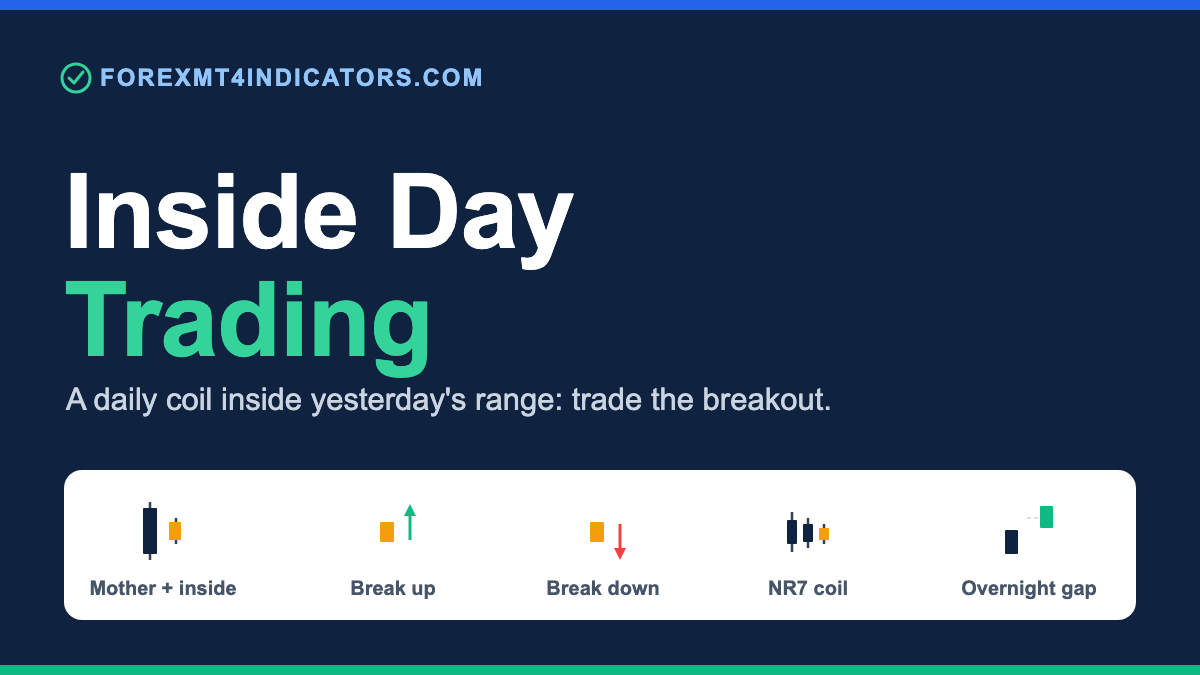
An inside day is one D1 candle fully contained by the previous D1 candle. The current day’s high is lower than yesterday’s high, and the current day’s low is higher than yesterday’s low. Nothing new happened outside yesterday’s range. The market coiled.
We call the previous day the mother day. Its high and low become the two lines that matter. The inside day sits between them like a spring under compression, waiting for one side to give way.
An inside day is a volatility-contraction signal, not a direction signal on its own. It tells you a move is loading, not which way it fires. That distinction is what separates traders who profit from inside days from those who guess.
Inside days show up in every market: forex majors, indices, and gold. As a rough rule of thumb rather than a measured rate, you might see one every week or two on a trending pair; they cluster more often when a pair consolidates before a central-bank event.
Why an inside day matters for swing traders
An inside day compresses the daily range, and compressed ranges tend to expand. That expansion is the trade. When yesterday’s fight ends in a draw, the next resolution often runs further than a normal day because stops sit on both sides of a tight box.
The setup fits swing and position traders because it lives on the D1 close. You do not need to watch every candle. You mark two levels after the 5:00pm New York close (about 21:00–22:00 GMT, depending on US daylight time), set your orders, and let the break come to you.
This same logic drives the inside bar forex swing trading strategy, only the daily version holds for days instead of hours. The trade-off is real: bigger moves, but overnight exposure you have to manage. We cover that exposure below.
Inside day vs inside bar: what is the difference
Traders mix these two up constantly, and the confusion costs money. They share a shape but trade differently because the timeframe changes everything: hold time, gap risk, and cost structure.
| Inside day (D1) | Inside bar (intraday) | |
|---|---|---|
| Structure | Daily candle inside prior daily candle | M15–H4 candle inside prior candle |
| Signal | Multi-session volatility contraction | Short-term pause within a session |
| Hold time | Overnight to several days | Minutes to hours |
| Main risk | Weekend and holiday gaps, swap cost | Spread cost, intraday whipsaw |
| Best used for | Swing and position entries | Intraday breakouts and continuation |
| Our guide | This page | Inside bar strategy |
The short rule: if you close the trade the same session, you are trading an inside bar. If you hold it past the daily close, you are trading an inside day and you inherit gap and swap risk. Treat them as two setups, not one.
The anatomy of an inside day
The mother day (prior day’s range)
The mother day is the reference candle. Its high and its low are the only two prices you need to mark. A wide mother day gives you a roomier box; a narrow one gives you a tighter, faster-resolving setup.
The size of the mother day sets your risk. Break from the inside day’s edge and your stop can sit inside the mother day’s range, which keeps the loss smaller than a full mother-day breakout would.
The inside day itself
The inside day is the coil. The tighter it sits relative to the mother day, the more compressed the spring and the sharper the expected expansion. A doji or small-bodied inside day signals the cleanest balance between buyers and sellers.
Watch where the inside day closes. An inside day closing near the top of its range hints at a bullish resolution; one closing near the bottom leans bearish. It is a lean, not a guarantee: plenty of inside days break against their close.
NR7 and coiling context
An NR7 is the narrowest range of the last 7 days, a pattern documented in Toby Crabel’s work on short-term price patterns. When an inside day is also an NR7, the compression is unusually tight and the following expansion tends to be stronger. This overlap is called an ID/NR7.
Some traders use ID/NR4 instead: an inside day that is also the narrowest range of the last 4 days. NR4 fires more often than NR7, so you get more signals with slightly less compression behind each one. Both are coiling filters; use NR7 for the highest-quality, lower-frequency setups.
How to trade the inside day breakout: entry, stop, target rules
Entry rules
- Entry trigger: a buy-stop order 2 to 5 pips above the inside day’s high, or a sell-stop 2 to 5 pips below its low. The order fires only if price actually breaks the box.
- Direction filter: take the break that agrees with the D1 and W1 trend. Skip counter-trend breaks unless price sits at a clean weekly range edge.
- Timeframe: mark levels on the D1 close (the 5:00pm New York close, about 21:00–22:00 GMT depending on daylight time). This is a daily setup: do not drop to M5 to chase an early poke.
You can trade two versions of the break. The inside-day break enters at the box edge for a tight stop; the mother-day break waits for price to clear the wider prior-day range for fewer false signals.
| Approach | Entry trigger | Stop placement | Best when |
|---|---|---|---|
| Inside-day break | Order 2–5 pips beyond the inside day’s high or low | Opposite side of the inside day, beyond the wick | Tight coil, trend continuation |
| Mother-day break | Order beyond the prior (mother) day’s high or low | Opposite side of the mother day | Wider range, you want fewer false breaks |
Stop loss
Place the stop on the far side of your chosen box, beyond the wick, with a small buffer. For an inside-day break long, that means below the inside day’s low. For a mother-day break, it means below the mother day’s low: a wider stop, so size the position down to match.
Never tuck the stop inside the inside day’s range. A stop there sits in the noise zone and gets tagged on the retest before the real move. The buffer beyond the opposing wick is what keeps you in the trade.
Take profit
- Target 1: a measured move equal to the mother day’s range projected from the breakout level. Bank part of the position here.
- Target 2: the next D1 swing high or low, or a prior weekly level.
- Manage: move the stop to breakeven once price closes a full daily candle beyond the box. On a strong expansion, trail behind each new D1 low (for longs) or high (for shorts).
Realistic reward on a clean inside-day break runs 1:2 to 1:3 when the expansion follows through. If price stalls back inside the box within a day, treat the break as failed and stand aside.
The overnight-hold consideration
An inside-day trade holds past the daily close by design, so you carry overnight risk the intraday trader never touches. You pay or earn swap each night, and you sit exposed to weekend gaps and scheduled news. Size for the gap you cannot see, not only the stop you can.
Check the economic calendar before you arm the orders. Avoid holding an inside-day break through NFP, CPI, or an FOMC decision unless that event is the catalyst you want: a high-impact release can gap price straight past your stop. Set price alerts at both box edges so a fill never surprises you.
Detecting these setups by eye across dozens of pairs is slow. An inside bar MT4 indicator can flag the D1 pattern automatically, and a multi-timeframe inside bar indicator for MetaTrader 4 lets you scan the daily setup while working a lower chart. Use them to build the watchlist, then apply the trend filter yourself.
Inside day on XAU/USD (gold)
Gold prints inside days like any market, but the resolution runs bigger and faster, so the numbers change. Frame gold in price distance first: with XAU/USD trading around $4,000+ in 2026, it moves an average of $60 to $110 per ounce per day, and an inside-day break can add another $60 to $120/oz on a strong expansion.
Turn that distance into cash before you size. A standard lot is 100 oz, so a $1.00/oz move equals $100 per standard lot; a 0.01 lot equals $1 per $1.00/oz move. On the house convention, $0.01 = 1 pip = $1 per pip per standard lot, but for a swing hold, think in dollars per ounce and total cash risk, not pip counts.
Widen the stop on gold. Gold’s daily wicks are longer than a forex pair’s, so a stop that hugs the inside day’s low gets speared and reversed. Give it an extra $6 to $16/oz of buffer beyond the wick and drop your lot size to keep the same cash risk.
Gold gaps hardest around the Sunday open and macro releases. An inside-day break held over the weekend can gap $30 to $60/oz against you before your stop ever triggers, so trim size or skip the hold ahead of CPI, NFP, and FOMC. Real-yield shifts move gold overnight even when forex sleeps.
Where the inside day fails
Inside days fail in three named conditions, and knowing them keeps you out of the worst breaks. First, low-volume holiday sessions: thin liquidity produces a break that has no follow-through and snaps back into the box within a day. Skip inside-day breaks around Christmas week, major bank holidays, and the last two sessions of December.
Second, counter-trend breaks. An inside day inside a strong D1 or W1 trend usually resolves with the trend; the break against the trend is the trap that hunts stops before reversing. When the box sits mid-trend, trade only the continuation break.
Third, the inside day inside a range. When the mother day is itself stuck in a wider consolidation, both edges get poked and neither holds: you get whipsawed long then short. Wait for price to sit at a clean range boundary before you trust the break.
The overnight gap is the fourth failure mode, and it is the cruel one. A weekend or news gap can jump the box entirely, filling you far from the level or blowing past a stop that looked safe on Friday. This is exactly why position size on an inside-day hold accounts for the gap, not the visible stop distance.
Common mistakes traders make with inside days
Trading every inside day regardless of trend. An inside day is context-dependent, and counter-trend breaks fail more often. Fix: only take the break that agrees with the D1 and W1 trend, or wait for a clean weekly range edge.
Placing the stop inside the box. A stop tucked within the inside day’s range sits in the retest noise and gets tagged before the real move. Fix: place it beyond the opposing wick of your chosen box, with a small buffer.
Chasing an intraday poke instead of a confirmed break. Price often pierces the box on M5 then closes back inside. Fix: use resting buy-stop and sell-stop orders 2 to 5 pips beyond the level, or wait for the D1 close beyond it.
Ignoring the economic calendar and holiday sessions. A break on thin holiday liquidity or seconds before high-impact news is a coin flip. Fix: check ForexFactory; skip inside-day breaks during holiday weeks and ahead of NFP, CPI, and FOMC.
Confusing the daily inside day with the intraday inside bar. They demand different hold times, stops, and risk controls. Fix: treat the inside day as a D1 overnight setup; for M15 and H1, use the inside bar price action strategy.
Risking full size on an overnight hold. The visible stop ignores gap risk, so a weekend jump can multiply the loss. Fix: size for the worst-case gap you have seen on that instrument, not the stop distance on the chart.
Frequently asked questions
What does an inside day mean in trading
An inside day means the current daily candle’s high and low both sit inside the previous day’s range. It signals a pause and volatility contraction: buyers and sellers reached a temporary balance. Inside days often precede a larger move, so traders watch the break of the day’s high or low as an early breakout signal.
How do you trade an inside day
Mark the inside day’s high and low after the daily close. Place a buy-stop 2 to 5 pips above the high and a sell-stop below the low, then take the break that agrees with the D1 trend. Stop goes beyond the opposite wick; first target is a measured move equal to the mother day’s range.
What is the difference between an inside day and an inside bar
They share the same shape but trade on different timeframes. An inside day is a D1 candle inside the prior D1 candle, held overnight as a swing setup with gap and swap risk. Traded intraday on M15 to H4, the same inside bar opens and closes within hours, exposed to spread and whipsaw instead of gaps.
Is an inside day bullish or bearish
An inside day is neutral on its own. It is a contraction signal, not a direction signal. The clue comes from context: an inside day near the top of a D1 uptrend leans bullish, one at the bottom of a downtrend leans bearish. Let the actual break of the box confirm direction before you commit.
What is an NR7 inside day
An NR7 inside day is an inside day that is also the narrowest range of the last 7 sessions, a double compression called an ID/NR7. The tighter the coil, the stronger the expansion that tends to follow. It fires less often than a plain inside day but filters for the highest-quality breakout setups.
Does the inside day pattern work on gold (XAU/USD)
Yes, but the numbers scale up. Gold moves $60 to $110 per ounce a day in 2026, so an inside-day break can run $60 to $120/oz. Widen the stop an extra $6 to $16/oz beyond the wick for gold’s longer wicks, cut your lot size to match, and avoid holding through the Sunday open or CPI, NFP, and FOMC.
Should I hold an inside day breakout overnight
Holding overnight is the point of the daily setup, but manage the exposure. You pay or earn swap each night and carry weekend and news-gap risk that an intraday trade avoids. Size the position for the worst-case gap you have seen on that instrument, set alerts at both box edges, and skip holds through high-impact releases.
Why do inside day breakouts fail
Four conditions cause most failures: thin holiday liquidity that gives no follow-through, counter-trend breaks that hunt stops before reversing, an inside day stuck inside a wider range that whipsaws both edges, and overnight gaps that jump the box. Filter with the D1 trend, trade clean range edges, and check the calendar before you arm orders.
Glossary of related terms
- Inside day: a daily candle whose high and low sit inside the prior day’s range; a volatility-contraction signal.
- Mother day (mother candle): the prior daily candle whose high and low define the box the inside day sits within.
- Inside bar: the same pattern on lower timeframes (M15 to H4), held for hours rather than overnight; see the inside bar price action strategy.
- NR7: the narrowest daily range of the last 7 sessions; signals strong compression.
- NR4: the narrowest daily range of the last 4 sessions; a more frequent, slightly weaker coil.
- ID/NR7: an inside day that is also an NR7; a high-quality coiling setup.
- Volatility contraction: a shrinking range that historically precedes a range expansion.
- False break: a move beyond the box that reverses back inside within a session or day.
- Overnight hold: carrying a position past the daily close, incurring swap and gap risk.
- D1: the daily timeframe, one candle per trading day.
Related reading
- Inside bar price action strategy: the inside bar pattern across all timeframes and its rules.
- Inside bar forex swing trading strategy: how to swing the inside bar across sessions.
- Inside bar MT4 indicator: auto-detect the pattern on your charts.
- Multi-timeframe inside bar indicator for MetaTrader 4: scan the daily setup while trading a lower chart.
- Free forex candlestick cheat sheet: a printable reference for the single- and multi-candle patterns behind these breaks.
If you want the reading logic behind coiling candles laid out end to end, The Candlestick Playbook ($27 ebook) collects the patterns into one reference, and the Price Action Masterclass ($97 video course) walks through range-and-break setups on live charts. Both are optional. The rules above stand on their own.
Risk disclaimer: Forex and CFD trading carries a high level of risk and may not be suitable for all traders. The strategies and indicators described in this article are educational. Past performance does not guarantee future results. Always test on a demo account before risking real capital.
Ready to put this into practice?
Open an account with a regulated broker and apply what you have learned. These are the three brokers we recommend:
Trading forex and CFDs carries a significant risk of loss and is not suitable for everyone. Broker links are affiliate links — we may earn a commission at no cost to you.